Table of Contents
ToggleInduction Ventilation and the Role of Jet Fans
In long tunnels and enclosed car parks, air does not move evenly by itself. Hot gases, vehicle exhaust, and smoke tend to collect in pockets. Jet fans give designers a way to push and steer that air without building large duct networks.
They create high-velocity air jets that drag surrounding air with them. That induced flow clears pollutants toward extract points and shapes smoke movement during fire scenarios.
How a Jet Fan Moves and Controls Air
Thrust, velocity, and entrainment
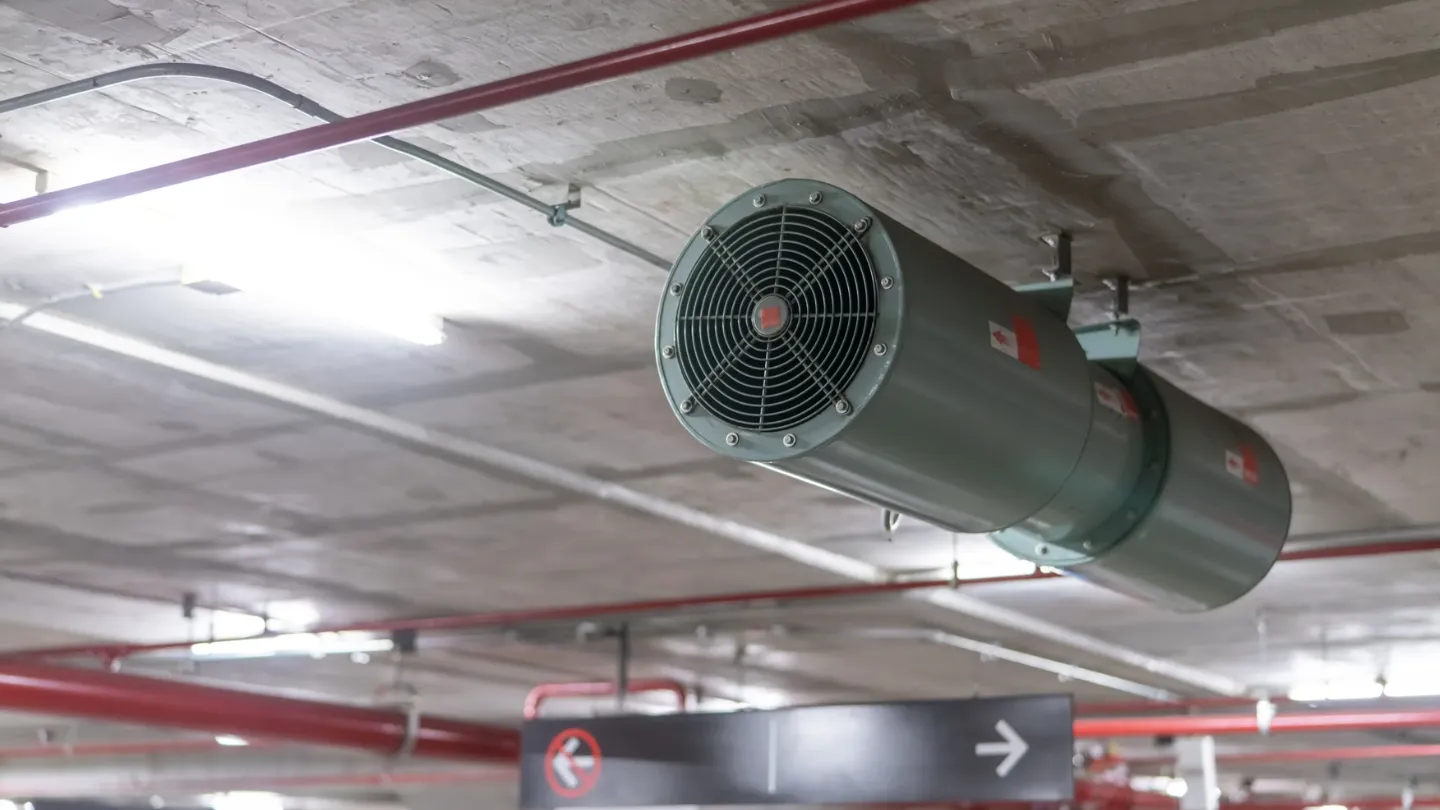
A jet fan looks like a short axial fan inside a cylindrical casing. When it runs:
- The impeller accelerates air and throws it along the tunnel or car-park ceiling.
- The resulting jet has momentum, expressed as thrust in newtons.
- That jet entrains surrounding air and pulls a much larger volume in the same direction.
Engineers focus on thrust rather than just m³/h or CFM, because thrust decides how strongly the jet overcomes resistance and drives longitudinal AIRFLOW CONTROL.
Unidirectional and reversible designs
Two main constructions appear in practice:
- Unidirectional jet fans – Move air in one designed direction. They often deliver slightly higher efficiency.
- Reversible jet fans – Use special blade profiles or pitch settings so they can reverse flow. They support flexible smoke strategies and reversible traffic conditions.
Selection depends on fire strategy, normal ventilation concept, and operational needs.
Jet Fans in Tunnels and Enclosed Car Parks
Normal ventilation mode
In day-to-day operation, jet fans:
- Dilute and remove CO, NOx, and heat from vehicles.
- Support acceptable visibility and comfort for drivers and maintenance staff.
- Reduce or avoid large longitudinal ducts by using the tunnel volume itself as the “duct.”
In enclosed car parks, ceiling-mounted jet fans push air toward exhaust points and fresh-air inlets, often under demand-controlled sequences based on CO sensors.
Fire and smoke-control mode
During a fire, the ventilation objective changes quickly. Depending on the fire strategy, jet fans may:
- Drive smoke in one direction to keep escape routes or intervention zones clearer.
- Support extraction at specific shafts or portals.
- Work with bulk exhaust fans and dampers as part of a defined FIRE SAFETY sequence.
Fire-mode operation relies on certified temperature classes and documented run times, so selection and control design must follow the applicable tunnel or car-park code.
Core Parameters for Jet Fan Selection
Thrust rating and aerodynamic efficiency
The thrust of a jet fan, often quoted in newtons at free jet conditions, sits at the center of selection. Designers check:
- Thrust at selected speed and density.
- Efficiency, which affects absorbed power and breaker sizes.
- Residual thrust after accounting for installation factors such as nearby soffits or obstacles.
The total installed thrust in a zone must satisfy calculations for both normal ventilation and design fire scenarios.
Noise, temperature class, and certification
Other key criteria include:
- Noise levels inside tunnels and car parks, with or without silencers.
- Temperature class and certified duration for smoke-control duty.
- Mechanical robustness, including corrosion protection and support details.
YAOAN VENTILATION data sheets should state these limits clearly, along with wiring, control, and maintenance requirements.
Layout Concepts and Calculation Approach
From design objectives to thrust demand
A typical engineering route runs as follows:
- Define objectives: pollutant limits, air velocities, and smoke-control targets.
- Set design scenarios: peak traffic, stalled vehicles, worst-case fire size and location.
- Calculate required longitudinal air velocities and pollutant dilution.
- Derive total thrust needed to create those velocities against friction, slopes, and local losses.
Once the total thrust per zone is known, designers select the number and rating of jet fans and verify results with detailed calculations or modeling.
Spacing, mounting height, and zoning
Jet fan layout translates calculations into a physical scheme:
- Fans mount near the ceiling to keep the path clear for vehicles and to interact with the warm layer in a fire.
- Spacing follows thrust reach and overlap so jets “hand off” airflow along the length.
- Zones align with power supplies, control groups, and fire-fighting tactics.
In car parks, designers also consider structural beams, sprinkler layouts, and headroom, then choose jet positions that respect these constraints while maintaining coverage.
Controls, sensors, and system integration
Jet fans rarely operate alone. They integrate with:
- CO and NOx sensors or visibility sensors in normal mode.
- Fire detection and incident management systems in emergency mode.
- Bulk supply and exhaust fans, dampers, and pressure-control devices.
Control sequences define which jet fans run, at what speed, and in which direction under each scenario. Clear logic avoids conflicting flows and protects both occupants and responders.
Installation and Maintenance Considerations
Good design fails without correct installation and care. Practical points include:
- Rigid supports that handle fan weight and dynamic loads.
- Correct orientation of airflow arrows and cable entries.
- Safe access for inspection, cleaning, and bearing or motor work.
- Periodic test runs in both normal and fire modes, with logged results.
Documented O&M procedures keep jet fans ready for rare but critical FIRE SAFETY events as well as daily air-quality control.
FAQ
What is a jet fan used for?
A jet fan creates a high-velocity air stream that drives surrounding air along with it. In tunnels and enclosed car parks, designers use jet fans to provide longitudinal ventilation, dilute vehicle emissions, and control smoke movement in accordance with the overall fire strategy.
What is the difference between axial fan and jet fan?
A jet fan is a specific application of an axial fan in a compact casing, optimized for thrust rather than only volume flow. Standard axial fans move air through ducts or openings; jet fans use their discharge momentum to induce airflow over long distances in open tunnel or car-park spaces.
What is a fan jet?
In aviation, a “fan jet” usually refers to a type of aircraft engine that uses a large fan to accelerate air. In HVAC and tunnel ventilation, “jet fan” describes a compact axial fan assembly that produces a directed air jet. Both use jet momentum, but they serve very different industries and safety frameworks.
What is the principle of jet fan?
A jet fan relies on momentum transfer. It accelerates a core air stream, which then entrains surrounding air and pulls it along the same direction. The resulting induced flow allows designers to move large volumes of air through tunnels or car parks without full-length duct systems.
What happens if a bird hits a plane turbine?
Bird strikes on aircraft turbines can damage blades, reduce thrust, or, in severe cases, cause engine failure. Aviation engines follow strict certification tests, and pilots train for such events. Anyone concerned about flight safety should refer to aviation authorities and official guidance rather than building ventilation practices.
Why is it called a jet?
The term “jet” refers to a narrow, high-speed stream of fluid. Jet fans create this type of air stream at their outlet, which then entrains surrounding air. The focus lies on the momentum of that jet, not only on the volume flow through the fan casing.
What type of fan pushes the most air?
The fan that “pushes the most air” depends on how you define the task. Large axial or mixed-flow fans, including jet fans, move very high volumes at moderate pressures. Centrifugal fans can deliver high pressures for ducted systems. The best choice depends on required flow, pressure, and layout.
About YAOAN VENTILATION
YAOAN VENTILATION delivers optimized air and airflow management solutions backed by nearly three decades of engineering experience. Since 1996, we have focused on industrial-grade ventilation and fire protection systems for commercial buildings, infrastructure, and specialized environments. Our jet fan range works alongside axial and centrifugal fans, dampers, and smoke-control components to support induction ventilation in tunnels and enclosed car parks. By combining certified thrust ratings, robust mechanical design, and clear control integration, YAOAN VENTILATION helps projects achieve stable AIRFLOW CONTROL, effective FIRE SAFETY performance, and reliable operation over the full service life of each installation.