Table of Contents
ToggleDirect Drive vs Belt Drive in Real HVAC Projects
In any fan schedule, the power section usually reveals one key choice: direct drive or belt drive. That decision affects efficiency, maintenance load, footprint, and how precisely the fan follows the design duty over time.
Instead of treating direct drive as “new” and belt drive as “old,” it helps to view them as two different ways to match fan speed and torque to the required AIRFLOW CONTROL.
How Direct-Drive Fans Are Put Together
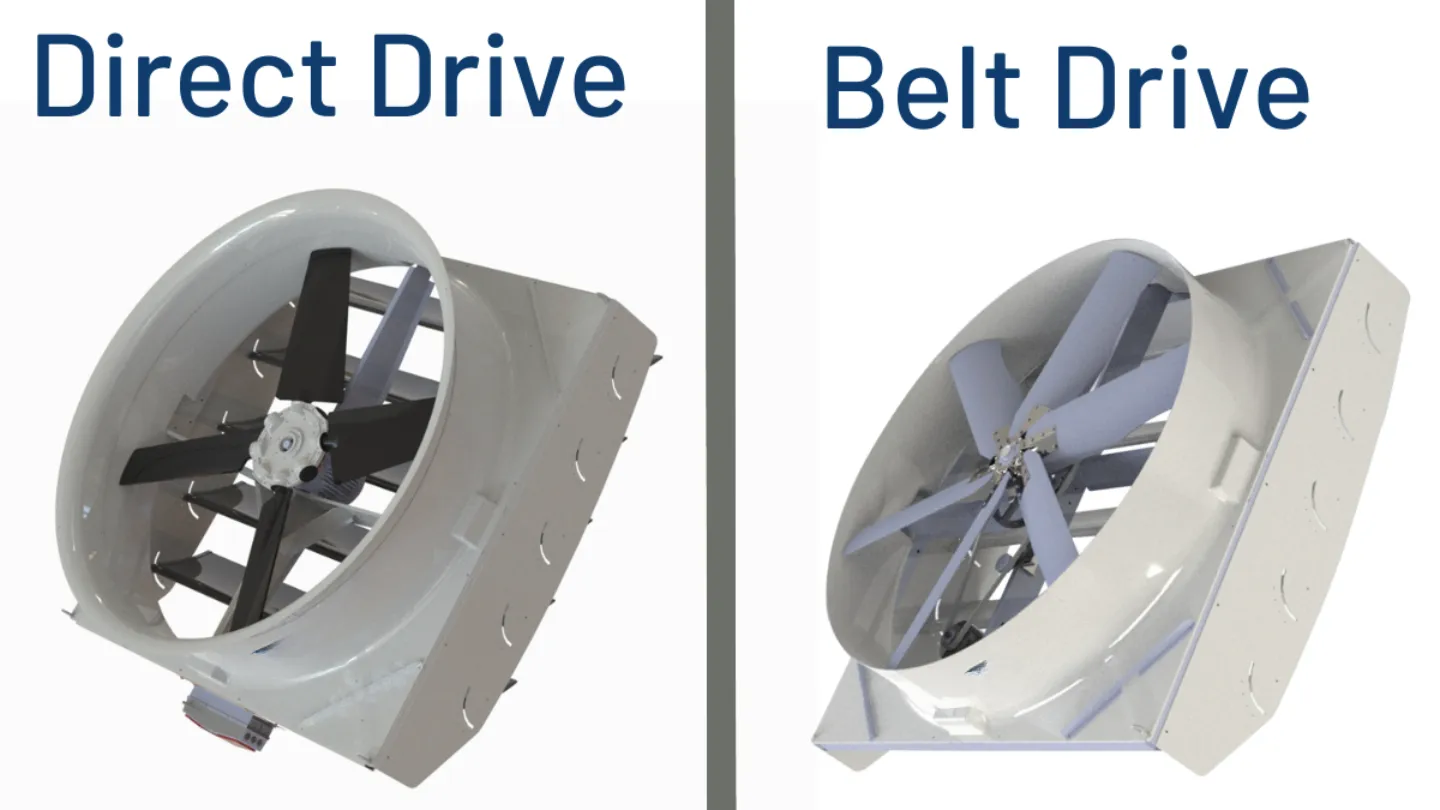
Direct-drive fans couple the motor shaft directly to the fan wheel or impeller. There are no belts, pulleys, or external speed ratios.
Typical characteristics:
- Motor and impeller share a common shaft or integrated hub.
- Speed control comes from motor pole count or, more often today, a variable frequency drive (VFD).
- Fewer rotating parts mean fewer mechanical losses between motor and air power.
This simple mechanical chain often improves efficiency and reduces the chance of misalignment in long-term operation.
Belt-Drive Fans: The Traditional Layout
Belt-drive fans place the motor aside and use belts and pulleys to turn the fan shaft. The pulley ratio sets the fan speed.
Key features:
- Fan speed can be adjusted by changing pulley sizes.
- Motor sits outside the airstream in many designs, which can help temperature and contamination management.
- The driveline includes belts, pulleys, and additional bearings that need inspection and tensioning.
Many older air-handling units, rooftop units, and exhaust fans in existing buildings still rely on this arrangement.
Efficiency and Energy Considerations
Direct-drive systems usually waste less power between the motor and impeller. There are no belt slip losses or extra bearings in the driveline. When combined with high-efficiency motors and VFDs, that can:
- Reduce electrical consumption at part load.
- Keep fan power aligned closely with calculated brake horsepower.
- Lower heat gains in plantrooms and fan compartments.
Belt-drive fans introduce additional losses, especially when belts slip or tension drifts. However, in some retrofit cases, adjusting pulley ratios offers a simple way to fine-tune flow without replacing the motor or fan.
Maintenance: What Changes for the O&M Team
Direct-drive maintenance
Technicians focus on:
- Bearing condition and lubrication, as defined in the O&M manual.
- Motor cleanliness, cooling path, and electrical checks.
- Vibration trends that might indicate balance or alignment issues.
The absence of belts simplifies inspections and reduces the number of periodic tasks.
Belt-drive maintenance
Belt-drive systems demand more routine attention:
- Regular belt tension checks and alignment of sheaves.
- Inspection for belt wear, cracking, glazing, or fraying.
- Replacement of belts at defined intervals or when condition drops.
Poor belt maintenance shows up as noise, vibration, reduced airflow, and wasted power. In critical FIRE SAFETY applications, neglected belts can compromise emergency fan performance.
Cost and Lifecycle Trade-Offs
Up-front prices vary by size, specification, and local market, but general patterns appear:
- Smaller and medium fans: direct-drive designs are often price-competitive when you include the VFD and reduced hardware.
- Large traditional AHUs: belt-drive fans sometimes show a lower purchase price, especially in simple constant-speed systems.
Lifecycle cost shifts the picture. When energy use, belt replacement, downtime, and call-outs are included, many projects find that well-selected direct-drive fans offer lower total cost over the system life—especially where VFD control already exists for other reasons.
When Direct Drive Makes Strong Sense
Direct-drive solutions fit particularly well when:
- The project uses VFDs for most fans as standard practice.
- Access for belt changes is difficult or labor-intensive.
- Stable, predictable efficiency matters over long operating hours.
- Noise and vibration limits are tight and consistent performance is important.
They also support compact fan arrays and modules where space and weight need careful control.
Where Belt-Drive Fans Still Have a Role
Belt-drive fans continue to make sense in some scenarios:
- Retrofit projects that reuse existing fans and motors but need flow adjustment via pulley changes.
- Systems where motors must stay fully outside contaminated or hot airstreams and direct-drive options are limited.
- Installations with infrequent operation where belt maintenance remains manageable and energy savings are less critical.
In these cases, clear maintenance procedures and good access become essential parts of the design.
FAQ
What is the meaning of direct drive?
Direct drive means the motor drives the load without belts, gears, or other mechanical speed reducers. The motor shaft connects directly to the driven component, such as a fan wheel, which simplifies the driveline and reduces mechanical losses.
What is a direct drive fan?
A direct-drive fan has its impeller mounted on the motor shaft or on a common shaft with no belt transmission. Speed control comes from the motor design or a variable frequency drive, and the arrangement reduces the number of moving parts that require regular adjustment.
What does direct drive do?
Direct drive transfers motor torque straight to the load, improving efficiency and response. In HVAC, it helps fans follow control commands accurately, reduces slip, and lowers maintenance associated with belts and pulleys.
What are the benefits of a direct drive motor?
Direct-drive motors offer higher overall efficiency, fewer wear components, and often better low-speed control with VFDs. They simplify maintenance, reduce noise from mechanical drives, and can improve reliability where fans run many hours per year.
Why don’t they put attic fans in houses anymore?
Many homes now rely on better insulation, air sealing, and mechanical ventilation or whole-house systems instead of traditional attic fans. Local codes, energy concerns, and moisture management practices influence that shift, so homeowners should consult regional guidance and qualified HVAC contractors for current best practice.
Which is better direct drive or belt drive blower?
Neither option fits every case. Direct drive often wins on efficiency, control, and reduced maintenance. Belt drive still helps when you need simple speed adjustment by pulley changes or when motor location and temperature limits make direct drive difficult. The best choice depends on duty, access, and lifecycle priorities.
Which is better direct drive or normal washing machine?
In appliances, direct-drive washing machines typically use fewer mechanical parts and may offer smoother operation. “Normal” belt-drive machines can be simpler to service in some regions. The trade-offs resemble fan systems: efficiency and simplicity versus adjustability and legacy designs.
About YAOAN VENTILATION
YAOAN VENTILATION delivers optimized air and airflow management solutions backed by nearly three decades of engineering experience. Since 1996, we have focused on industrial-grade ventilation and fire protection systems for commercial buildings, infrastructure, and specialized environments. Our product range includes direct-drive and belt-drive fans, smoke-control units, dampers, silencers, and precision-built aluminum ventilation components. By comparing driveline options against real operating hours, maintenance capacity, and FIRE SAFETY duties, YAOAN VENTILATION helps project teams select fan systems that balance efficiency, reliability, and total lifecycle cost.