Smoke, Airflow, and Safety in Tunnel Fires
When a fire starts in a road or rail tunnel, smoke behaves like a separate hazard. Flames damage vehicles and structure locally, but smoke can travel hundreds of meters. If it drifts back toward people who try to evacuate upstream, escape routes and rescue operations fail quickly.
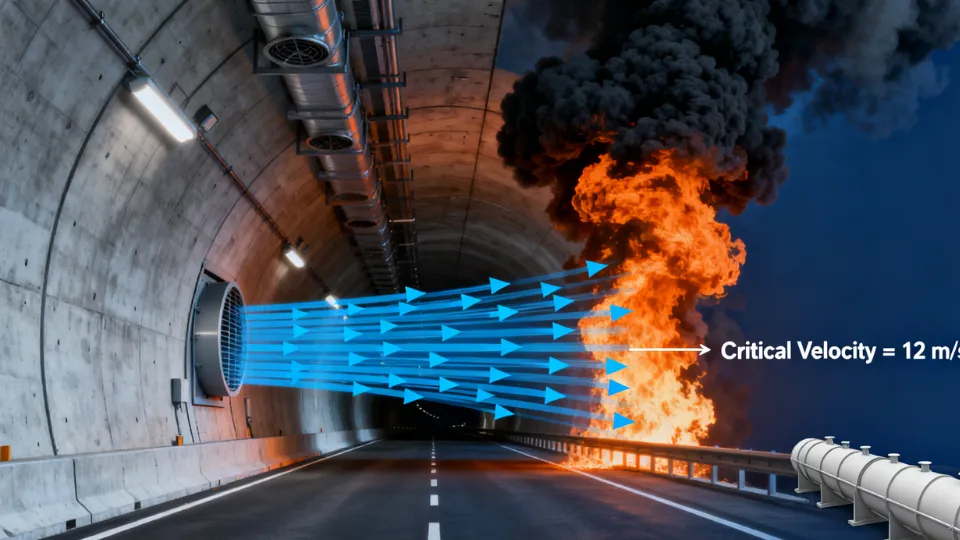
Tunnel ventilation designers use critical velocity as a key parameter to prevent that backflow. It links fire size, tunnel geometry, and airflow so that the system can keep smoke moving in a controlled direction.
What Engineers Mean by Critical Velocity
In tunnel ventilation, engineers describe critical velocity as the minimum longitudinal air speed in the tunnel that stops hot smoke from flowing upstream against the air stream. Above this speed, the jet from the ventilation system pushes smoke downstream, away from people moving to safe zones.
You can think of it as a balance point. The buoyancy of hot smoke tries to spread along the tunnel ceiling in both directions. The ventilation flow pushes in one direction. When the airflow at the fire location exceeds the critical value, smoke no longer back-layers upstream in a continuous layer.
Critical velocity does not aim to blow smoke away completely. It aims to maintain a smoke-free layer upstream of the fire long enough for evacuation and intervention.
Smoke Movement and Back-layering in Tunnels
How smoke behaves without control
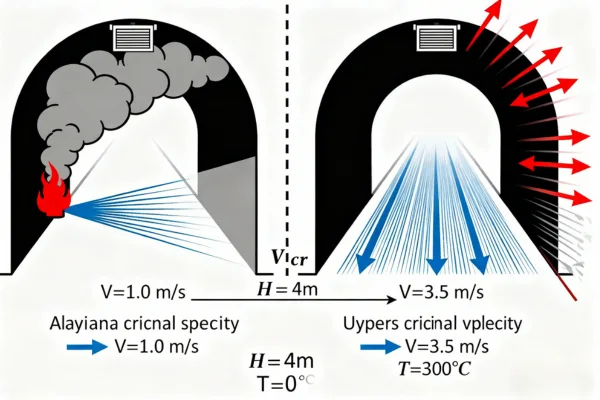
In a simple, unventilated tunnel fire:
- Hot smoke rises to the crown of the tunnel.
- Buoyancy drives it along the ceiling in both directions.
- A hot, low-visibility layer grows and pushes downward.
People upstream can lose visibility and breathable air quickly, even if the fire sits far away.
What happens near the critical point
As longitudinal flow increases, the pattern shifts:
- At very low velocities, smoke still back-layers upstream.
- Near critical velocity, the upstream layer becomes shorter and thinner.
- Above critical velocity, the upstream smoke layer breaks and no longer forms a continuous ceiling flow.
Designers want that third condition near exits and safe areas so upstream occupants see a clearer escape path.
Parameters That Influence Critical Velocity
Fire size and heat release
Stronger fires create more buoyant smoke and need higher tunnel air speeds to suppress back-layering. Engineers often use fire heat release rate (for example, megawatts) as a key input. Heavy-goods vehicles or fuel tankers represent more severe design cases than passenger cars.
Tunnel geometry and slope
Tunnel shape and gradient influence how easily smoke moves:
- A steeper uphill slope encourages smoke to drift upward, sometimes against the ventilation direction.
- Larger cross-sectional areas spread airflow, changing local velocity at the fire.
- Complex layouts such as bifurcations or large cross-passages complicate smoke patterns.
Models and guidelines help account for these effects rather than relying on a single “typical” velocity.
Ventilation system configuration
Longitudinal tunnel systems often use:
- Jet fans installed in the crown
- Full-length ducts with extraction points
- Hybrid schemes that combine longitudinal flow with local extraction
The arrangement of fans, dampers, and exhaust openings determines where and how the system can reach or exceed the required critical velocity.
From Design Formula to Real Tunnel Operation
Translating calculations into fan duties
Once the design team defines the critical velocity for representative fire scenarios, they translate that requirement into:
- Total thrust for jet fans
- Required flow rate for longitudinal ventilation
- Fan redundancy and failure cases
Engineers then check that fans can deliver that performance under realistic conditions—dirty surfaces, aging, and available power—not just in ideal, new-equipment calculations.
Control strategies during an incident
Critical velocity becomes meaningful only when control logic uses it correctly. Typical practices include:
- Activating specific jet fans in zones around the fire, not the whole tunnel at once
- Coordinating fan direction with evacuation plans so smoke moves away from upstream egress routes
- Using feedback from temperature, airflow, and visibility sensors to confirm that the system maintains the intended flow direction
In some designs, the system runs slightly above calculated critical velocity to include a safety margin for uncertainties in fire size and boundary conditions.
Integration with Fire Separation and Escape Planning
Critical velocity sits in the center of a broader life-safety strategy. A tunnel design that uses longitudinal smoke control also relies on:
- Fire-resistant structure and linings that endure high temperature for defined periods
- Safe escape routes with cross-passages to smoke-free areas or parallel tunnels
- Power supply and control systems hardened against fire and heat
Ventilation does not replace structural FIRE SAFETY or emergency planning. It supports them by keeping smoke away from zones where people move and where responders enter.
FAQ
What is the definition of critical velocity?
In tunnel ventilation, critical velocity means the minimum longitudinal air speed at the fire location that prevents a continuous upstream smoke layer. Above this speed, smoke flows mainly in one direction, so upstream areas stay clearer for evacuation and rescue.
What is critical velocity and escape velocity?
Critical velocity in tunnel design refers to airflow that controls smoke movement. Escape velocity belongs to orbital mechanics and describes the speed an object needs to leave a planet’s gravitational field without further propulsion. Both use the word “velocity,” but they apply to very different problems.
How to get critical velocity?
Engineers determine critical velocity by combining fire size assumptions, tunnel geometry, and empirical or analytical models. They study how buoyancy and airflow interact, then choose a target velocity that suppresses smoke back-layering with a safety margin. Fan selection and control logic must then deliver that velocity in real incidents.
What is the critical velocity of a liquid?
In fluid mechanics, critical velocity for a liquid usually refers to the speed at which flow changes character, such as from laminar to turbulent in a pipe. That definition does not match tunnel smoke control. In tunnels, critical velocity relates to gas flow and smoke, not to liquid flow in pipes.
How fast is critical velocity?
Typical design values for longitudinal tunnel ventilation often sit in the range of a few meters per second, but the exact number depends on fire size, tunnel slope, and cross-section. Engineers do not use a single fixed value; they calculate or simulate the required speed for each project and scenario.
What is critical speed in simple words?
Critical speed usually means a threshold speed where behavior changes significantly. In rotating machines, it marks a speed near a natural frequency where vibration increases sharply. In tunnels, critical speed of air relates to the point where ventilation flow starts to control smoke movement and stop upstream back-layering.
What does CV mean in running?
In a training context, CV often stands for “critical velocity” or “critical pace,” a running intensity athletes can sustain for a relatively long time while still producing strong performance. That use differs from tunnel ventilation but relies on the same idea of a threshold that separates manageable effort from unsustainable effort.
How fast do Navy Seals run 1.5 miles?
Training standards and actual performance vary by unit, test, and individual. Some published entry or screening standards expect times on the order of ten minutes or less for 1.5 miles, but specific requirements come from official military sources and can change over time.
Can a human really run 40 mph?
Current human sprint records sit far below 40 mph. Elite sprinters reach top speeds around 27 to 28 mph over very short distances. A 40 mph human sprint remains well outside observed performance and current biomechanics.
About YAOAN VENTILATION
YAOAN VENTILATION delivers optimized air and airflow management solutions backed by nearly three decades of engineering experience. Since 1996, we have focused on industrial-grade ventilation and fire protection systems for commercial buildings, infrastructure, and specialized environments. Our portfolio includes tunnel fans, smoke control components, dampers, silencers, and precision-built aluminum ventilation parts, all designed to support stable airflow and reliable smoke control. By integrating critical-velocity analysis with robust equipment and control strategies, YAOAN VENTILATION helps projects manage tunnel fire scenarios with greater confidence, life-safety protection, and long-term system reliability.