Cooling Fans in HVAC and Equipment Applications
In HVAC and building systems, a cooling fan is any fan that helps remove heat from people, components, or localized spaces. It does not change air temperature the way refrigeration does. Instead, it improves heat transfer through controlled airflow.
Cooling fans appear in homes, data rooms, factory floors, and near process equipment. In contrast, large industrial ventilation fans focus on moving air for the entire space, often through duct systems, rather than spot cooling specific locations.
How Cooling Fans Move Heat
Airflow and perceived cooling
A cooling fan creates a pressure difference that drives air across a room, body, or surface. As air moves:
- The warm boundary layer at the skin or equipment surface is stripped away.
- Evaporation of sweat or surface moisture increases, which carries heat off.
- Convective heat transfer improves, so surfaces shed heat into the airstream faster.
You feel cooler because your body loses heat more efficiently. The room temperature may not drop, but thermal comfort improves.
Key design parameters
Several design elements define how a cooling fan performs:
- Blade geometry: Diameter, pitch, and profile affect flow volume and velocity.
- Motor and speed control: Power rating and speed steps determine maximum airflow and noise.
- Mounting method: Floor, wall, ceiling, and equipment-mounted fans create different airflow patterns.
- Duty cycle and construction: Continuous-duty motors, bearings, and housings matter in industrial operation.
Engineers look at airflow rate, pressure capability, efficiency, and acoustic performance when specifying cooling fans for buildings and processes.
Residential vs Industrial Cooling Fans
Fans for household comfort
Residential cooling fans focus on user comfort and convenience. Common types include portable desk fans, pedestal fans, tower fans, box fans, and ceiling fans. Typical features are:
- Lightweight materials and compact form factor
- Simple controls with a few speed settings
- Low to moderate noise levels for bedrooms and living spaces
These units create personal cooling zones. They rarely integrate into building controls or ducted HVAC.
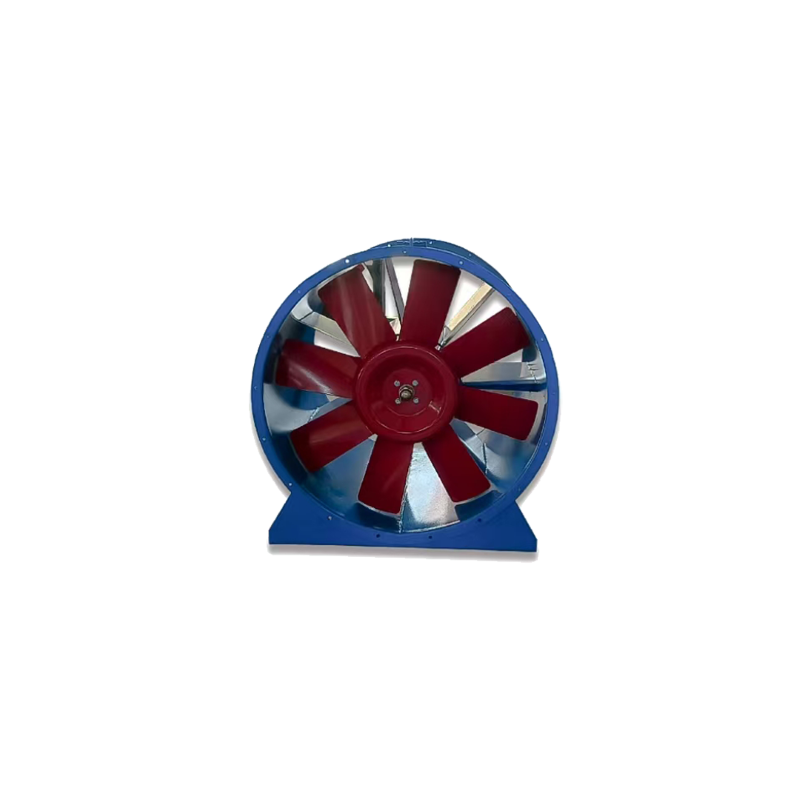
Fans for industrial and equipment cooling
Industrial cooling fans serve a different role. They protect equipment and workers in areas with persistent heat loads. Examples include:
- Fans inside control cabinets and enclosures
- Large portable fans for production lines and warehouses
- Fans mounted near ovens, furnaces, or molding machines
They often feature:
- Heavy-duty motors and frames for continuous operation
- Metal or reinforced blades and guards
- Adjustable stands or brackets for directional placement
- Options for speed control or integration with process interlocks
Here, the main goal is stable operation, reduced heat stress, and longer equipment life, not decorative comfort.
Cooling Fans vs Industrial Ventilation Fans
Different roles in building systems
Cooling fans and industrial ventilation fans both move air, but their objectives differ:
- Cooling fans focus on localized thermal comfort or equipment cooling.
- Ventilation fans manage air exchange, contaminant removal, and pressure control at the building or zone level.
Ventilation fans work with outdoor air, duct networks, filters, dampers, and grilles. They help maintain acceptable indoor air quality, temperature, and sometimes smoke management, while cooling fans mainly redistribute existing indoor air.
Airflow, pressure, and integration
Cooling fans typically deliver:
- Short-throw, high-velocity airflow near the fan location
- Low static pressure capability
- Minimal integration with HVAC controls
Industrial ventilation fans often provide:
- Higher total airflow for entire zones or buildings
- Enough static pressure to overcome duct friction and filtration
- Connection to BAS, safety interlocks, and code-driven control sequences
In many facilities, both are present. Ventilation fans maintain overall air quality and compliance, while cooling fans fine-tune comfort or equipment cooling at specific points.
Practical Use in Facilities and Homes
Placement and direction strategies
Fan placement determines how effective the cooling feels:
- Aim airflow across occupants rather than at obstructions.
- In equipment areas, direct air along hot surfaces and away from sensitive electronics.
- For ceiling fans, use the summer direction (typically counterclockwise when viewed from below) to push air downward and create a noticeable breeze.
Even small changes in location or direction can improve comfort without increasing fan size.
Working with windows and existing HVAC
Combining fans with room layout and outdoor conditions improves performance:
- When outside air is cooler, use fans near windows to draw cool air in or exhaust hot air out.
- When outdoor air is hotter or more humid, close windows and use fans to support air conditioning by mixing cooled air and reducing stratification.
- In long spaces, use multiple fans to promote crossflow and move hot air toward exhaust points or return grilles.
For industrial sites, engineers may pair cooling fans with mechanical ventilation to keep heat, fumes, and humidity within acceptable limits.
FAQ
How does the cooling fan work?
A cooling fan works by moving air across warm surfaces. The motor drives the blades, which create airflow. That moving air removes the warm boundary layer around your skin or equipment and improves convective heat transfer, so heat leaves the body or surface more quickly. Comfort improves even if air temperature stays nearly the same.
Which way to turn a fan for cool air?
For a typical ceiling fan, use the direction that pushes air downward during warm seasons, usually counterclockwise when viewed from below. That direction creates a direct breeze in the occupied zone. For portable fans, orient the fan so air flows across people or equipment, not into nearby walls or obstacles.
How does a fan cool you?
A fan cools you by increasing heat loss from your body. Moving air speeds up sweat evaporation and removes the thin layer of warm air at your skin surface. Your body releases more heat into the airstream, so you feel cooler. The fan does not reduce the room’s dry-bulb temperature the way air conditioning does.
How to cool down using a fan?
To cool down, place the fan so a steady breeze crosses your body while you sit or work. Avoid blocking the airflow with furniture, and wear breathable clothing so evaporation can occur. If the outdoor air is cooler, pair the fan with an open window to draw that cooler air into the space or exhaust hot air out.
Are cooling fans better than AC?
Cooling fans use much less energy than air conditioners, but they do not remove heat or moisture from the air. In mild or dry conditions, a fan can provide adequate comfort with low operating cost. In very hot or humid climates, air conditioning handles the main cooling load, and fans act as a support tool to improve comfort and reduce AC runtime.
Can I use a cooler fan without water?
You can run an evaporative cooler or “air cooler” without water, but it functions like a standard fan. It will still move air, yet you lose the extra cooling that comes from water evaporation. Always follow the manufacturer’s instructions to protect the pump, pads, and electrical parts designed to operate with water.
Can a fan cool down a hot room?
A fan alone does not lower the total heat in the room, but it can make occupants feel cooler. To actually cool the room, the fan needs to work with ventilation or a cooler air source. For example, it can move hot air toward an exhaust opening or help pull cooler outside air into the space when outdoor conditions allow.
Should you open a window when using a fan?
Open a window when the outside air is cooler or fresher than the indoor air. Then use the fan to draw that air in or push hot indoor air out. When outdoor air is hotter, very humid, or polluted, it is often better to keep windows closed and use the fan with air conditioning or mechanical ventilation instead.
How to turn fan into air cooler?
You can boost a fan’s cooling effect by combining airflow with evaporation or cooler surfaces. Place a stable pan of ice or cold packs in front of the fan, or use an evaporative cooler that pushes air through wet pads. Keep water away from electrical components and maintain clear inlets and outlets for safe operation.
About YAOAN VENTILATION
YAOAN VENTILATION delivers optimized air and airflow management solutions backed by nearly three decades of engineering experience. Since 1996, we have focused on industrial-grade ventilation and fire protection systems for commercial buildings, infrastructure, and specialized environments. Our product line includes fans, fire dampers, smoke control components, silencers, and precision-built aluminum ventilation parts, each manufactured to strict national standards and verified through rigorous testing. With dependable performance, technical support, and a commitment to long-term safety, YAOAN VENTILATION helps projects achieve stable system operation, efficient cooling, and consistent compliance across a wide range of applications.