Table of Contents
ToggleSupplying Air Based on Real Demand
Large commercial and public buildings rarely operate under constant load. Office floors empty after business hours, meeting rooms alternate between occupied and vacant, and public areas experience significant fluctuations throughout the day. Supplying a fixed airflow to every zone under these conditions leads to unnecessary energy consumption and unstable indoor comfort.
Variable Air Volume (VAV) systems respond to this challenge by adjusting airflow according to real demand. Instead of delivering the same air volume everywhere, the system supplies only what each zone requires at a given moment. This approach reduces fan energy, lowers cooling and heating loads, and improves overall HVAC efficiency.
How a VAV System Controls Airflow
Zone-Level Airflow Modulation
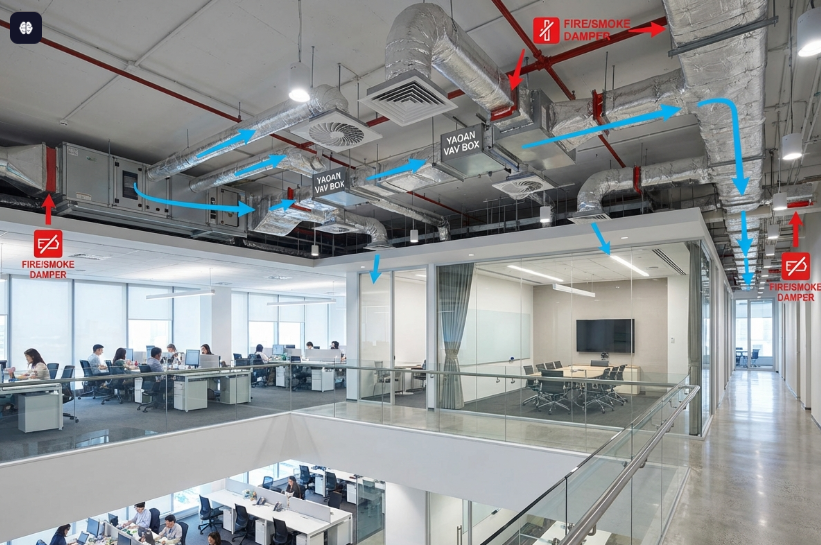
In a VAV system, each zone connects to the main supply duct through a VAV box. Inside the box, a control damper adjusts airflow based on temperature or occupancy signals. When thermal load decreases, airflow is reduced; when demand increases, airflow rises accordingly.
This localized control prevents over-conditioning and allows different areas of the building to operate efficiently despite varying usage patterns.
System-Level Fan Speed Regulation
As multiple zones reduce airflow, static pressure in the duct system increases. Variable frequency drives respond by reducing fan speed to maintain system balance. This coordinated control strategy is one of the main reasons VAV systems achieve significant energy savings.
Because fan power decreases rapidly as airflow drops, even modest reductions in air volume can lead to substantial energy reduction at the system level.
Key Components of a VAV HVAC System
Air Handling Units and Supply Fans
Air handling units provide conditioned air to the duct network. In VAV applications, they must operate reliably across a wide airflow range while maintaining stable temperature control, filtration efficiency, and humidity performance.
Correct selection ensures that part-load efficiency gains are not offset by poor control or operational instability.
VAV Boxes and Control Dampers
VAV boxes are the core regulating devices in the system. They must respond accurately at both high and low airflow rates while maintaining acceptable noise levels in occupied spaces. Proper sizing and installation are critical to avoid hunting behavior, drafts, or acoustic issues.
Sensors and Building Management Integration
Temperature sensors, pressure sensors, and occupancy detection guide airflow decisions. When integrated with a building management system, VAV control aligns HVAC operation with schedules, space utilization, and energy optimization strategies.
Fire Dampers and Safety Coordination
Fire dampers remain essential in VAV ductwork. During a fire event, airflow control must give way to compartmentation and smoke containment. Proper coordination between VAV boxes, fire dampers, and control logic ensures that energy-efficient operation does not compromise fire safety compliance.
Where VAV Systems Deliver the Greatest Benefits
Office Buildings and Mixed-Use Towers
Office buildings contain zones with very different load profiles. Open offices, meeting rooms, and support areas experience varying occupancy throughout the day. VAV systems adapt automatically, reducing energy consumption while maintaining stable indoor conditions.
Shopping Malls and Public Spaces
In shopping malls and large public areas, visitor density fluctuates continuously. VAV systems adjust airflow to match these changes, controlling operating costs without sacrificing comfort in high-traffic zones.
Hospitals and Healthcare Facilities
Healthcare buildings require precise airflow control and high indoor air quality. VAV systems support different airflow requirements for wards, operating rooms, and laboratories while integrating with fire and smoke control strategies.
Performance Data That Matters in VAV Design
Airflow Range and Minimum Settings
Designers must define minimum airflow limits carefully to maintain ventilation effectiveness and temperature stability. Oversized systems or aggressive minimum settings can reduce expected energy savings.
Noise and Pressure Drop
At reduced airflow, poorly selected VAV boxes may generate noise or instability. Reviewing sound data and pressure drop together ensures acceptable acoustic performance across all operating conditions.
Coordination with Duct Layout
VAV performance depends heavily on duct design. Proper balancing, sufficient straight duct runs, and accessible installation all contribute to stable long-term operation.
Design and Operational Considerations
Matching System Design to Real Usage
Effective VAV design begins with understanding how spaces are actually used. Occupancy patterns, internal heat gains, and operating schedules should drive zoning and control strategies.
Seasonal Operation and Control Strategy
VAV systems behave differently in cooling and heating modes. Control sequences must avoid issues such as overcooling, reheating conflicts, or warm air stratification during heating seasons.
Maintenance and Long-Term Reliability
Over time, sensors drift and space usage changes. Accessible VAV boxes, clear documentation, and periodic recommissioning help maintain energy performance throughout the building lifecycle.
FAQ
What is a VAV HVAC system?
A VAV system is an HVAC solution that varies the amount of air delivered to each zone based on real-time demand instead of supplying constant airflow.
How does a VAV system save energy?
By reducing airflow during low-demand periods, VAV systems lower fan energy consumption and reduce cooling and heating loads.
Are VAV systems suitable for large buildings?
Yes. VAV systems are widely used in offices, hospitals, shopping centers, airports, and other multi-zone buildings.
Do VAV systems require fire dampers?
Yes. Fire dampers are required to maintain fire and smoke compartmentation in ducted HVAC systems.
About YAOAN Ventilation
YAOAN Ventilation delivers engineered HVAC and airflow management solutions for commercial and public buildings. With experience in VAV systems, fire dampers, ventilation fans, and airflow control components, YAOAN supports energy-efficient operation, stable indoor comfort, and compliant fire safety in complex building environments.