Table of Contents
ToggleUnderstanding Project-Based HVAC Design
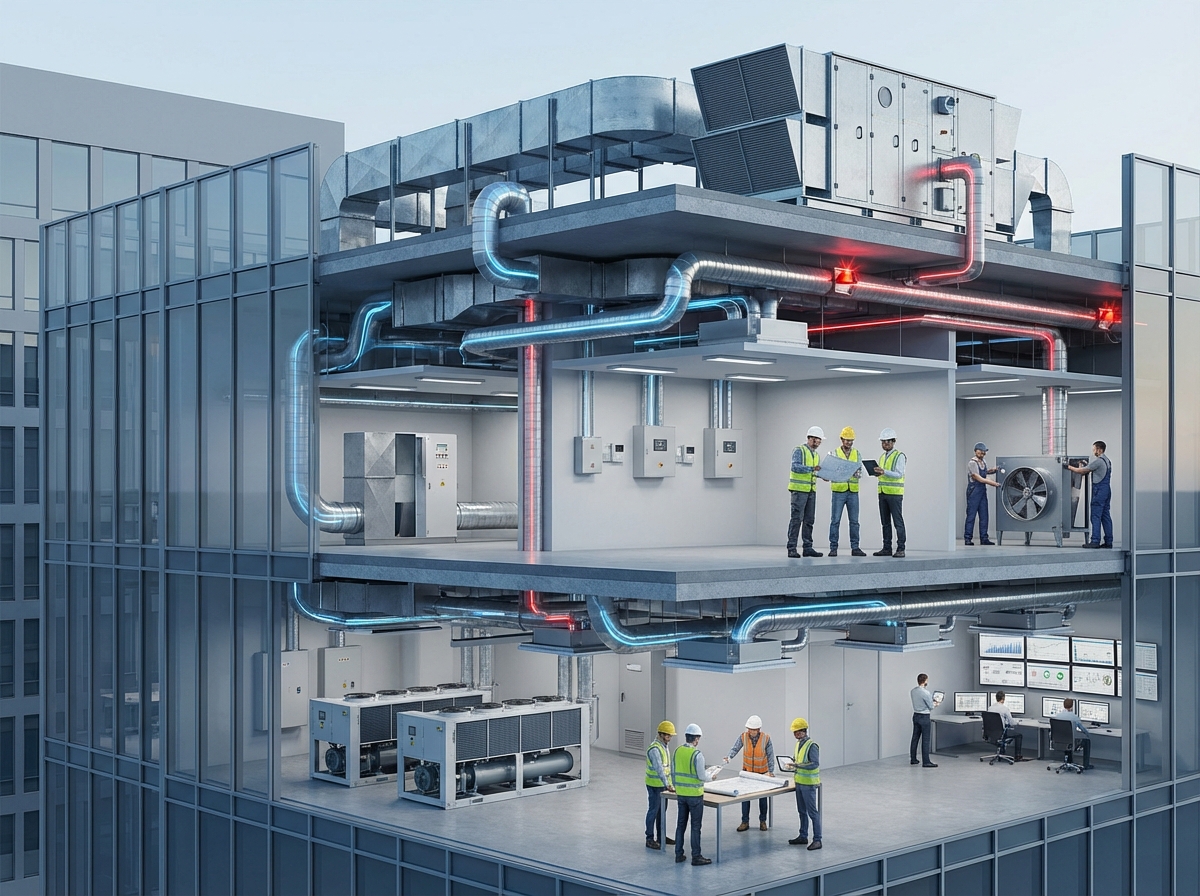
Project-based HVAC design ensures that systems are tailored to each building’s unique requirements. Unlike standard solutions, this approach considers:
- Building type, occupancy, and functional requirements
- Airflow, thermal comfort, and indoor air quality
- Fire safety, smoke control, and regulatory compliance
This methodology guarantees energy efficiency, reliable performance, and occupant comfort throughout the system’s lifecycle.
Conceptual Design Phase
Needs Assessment
- Identify building purpose: office, industrial, hospital, airport, or commercial complex
- Determine occupancy, zone layouts, and peak load conditions
- Evaluate environmental constraints: temperature, humidity, and air quality
System Selection
- Evaluate HVAC types: VAV, CAV, DOAS, or hybrid systems
- Consider fire and smoke control integration
- Analyze lifecycle costs for energy efficiency and maintenance
Preliminary Layouts
- Ductwork routing, diffuser placement, and fan selection
- Fire dampers, smoke vents, and emergency sequences
- Coordination with structural and architectural plans
Detailed Design Phase
Load Calculations and Simulation
- Heating, cooling, and ventilation loads for each zone
- CFD (Computational Fluid Dynamics) for airflow patterns and thermal comfort
- Smoke control simulation for fire scenarios
Equipment and Controls Specification
- Fans, chillers, boilers, VAV/CAV units, and ducting
- Fire dampers, smoke detectors, and emergency exhaust fans
- Building automation integration for real-time monitoring and energy optimization
Coordination and Compliance
- Integration with electrical, plumbing, and structural designs
- Compliance with local codes, NFPA, EN, and ASHRAE standards
- Documented design for permits and regulatory approval
Installation and Commissioning
Installation Best Practices
- Ductwork and equipment placement according to design
- Proper sealing, insulation, and vibration control
- Fire and smoke safety components installed and verified
Testing and Balancing
- Airflow measurement and balancing for each zone
- Functional testing of VAV/CAV boxes, fire dampers, and smoke exhaust systems
- Calibration of sensors and building automation controls
Commissioning
- Verification of system performance against design specifications
- Documentation of operational procedures and maintenance schedules
- Training for facility management personnel
Lifecycle Considerations
Maintenance Planning
- Scheduled inspections for fans, filters, dampers, and sensors
- Preventive maintenance to extend equipment life and maintain efficiency
Energy Management
- Continuous monitoring via building automation
- Adjustments to airflow, temperature, and energy usage based on occupancy and seasonal changes
Upgrades and Retrofits
- Future-proofing through modular design and flexible layouts
- Integration with energy-saving technologies or new regulatory requirements
FAQ
What is project-based HVAC design?
It is a tailored approach to HVAC design that considers the building’s unique requirements, from concept through commissioning and lifecycle management.
Why is project-based design important?
Custom designs ensure optimal airflow, comfort, energy efficiency, and regulatory compliance, avoiding generic solutions that may underperform.
How long does the commissioning process take?
Commissioning timelines vary based on building size and complexity but typically involve detailed testing, balancing, and verification over several weeks.
Can project-based HVAC design reduce operational costs?
Yes, by optimizing energy efficiency, system performance, and preventive maintenance, operational costs are significantly reduced over the system’s lifecycle.
About YAOAN Ventilation
YAOAN Ventilation provides end-to-end project-based HVAC solutions, from concept and design to installation and commissioning. Our expertise in energy-efficient airflow, fire and smoke safety, and system integration ensures reliable, compliant, and cost-effective HVAC performance for commercial, industrial, and public buildings.