Table of Contents
ToggleUnique Challenges in Large Infrastructure Projects
Large infrastructure projects—such as airports, metro systems, stadiums, and industrial complexes—require specialized HVAC solutions due to:
- Vast volumes and multiple functional zones
- Diverse occupancy and environmental requirements
- Integration of fire and smoke safety systems
- High energy consumption and sustainability goals
Tailored HVAC design ensures occupant comfort, energy efficiency, and regulatory compliance across the project lifecycle.
Key HVAC Considerations
Airflow and Ventilation Management
- Proper air distribution in large halls, tunnels, and atriums
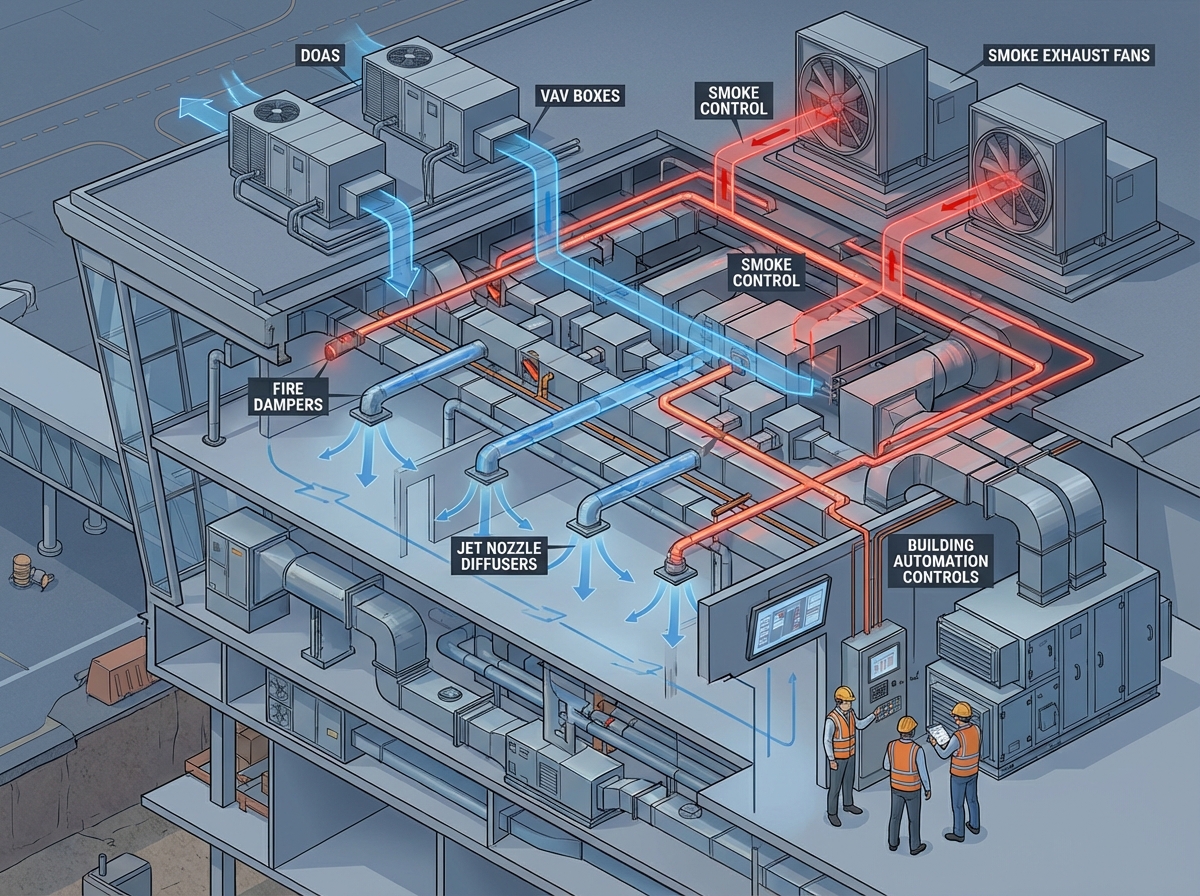
- Use of VAV systems, jet nozzles, and long-throw diffusers for uniform airflow
- CFD simulations for optimal diffuser placement and smoke control
Energy Efficiency and Sustainability
- Implementation of energy-saving systems such as VAV, DOAS, and heat recovery
- Smart building automation to adjust airflow, temperature, and energy usage in real time
- Reducing operational costs while maintaining comfort
Fire and Smoke Safety Integration
- Installation of fire dampers, smoke exhaust fans, and emergency vents
- Compliance with NFPA, EN, and local fire safety codes
- Automated control sequences to ensure safe evacuation
Maintenance and Lifecycle Management
- Accessible design for inspections and preventive maintenance
- Lifecycle cost analysis for energy, maintenance, and replacement planning
- Documentation for operational optimization and regulatory compliance
System Types for Large Projects
Variable Air Volume (VAV) Systems
- Zone-specific airflow control for comfort and efficiency
- Adaptive to occupancy and environmental conditions
Constant Air Volume (CAV) Systems
- Suitable for areas with steady loads
- Simpler control but higher energy consumption
Dedicated Outdoor Air Systems (DOAS)
- Optimizes ventilation and humidity
- Can reduce overall HVAC energy usage when integrated with main systems
Hybrid Systems
- Combines multiple strategies for complex infrastructure layouts
- Ensures optimal airflow, comfort, and safety
Design and Operational Best Practices
Load and Zone Analysis
- Accurate heating, cooling, and ventilation calculations for all zones
- Consideration of occupancy patterns, equipment heat loads, and environmental conditions
Automation and Monitoring
- Centralized Building Management System (BMS) for real-time control
- Predictive maintenance reduces downtime and prolongs equipment life
Equipment Selection
- Fans, chillers, diffusers, fire dampers, and sensors selected based on zone requirements
- Prioritize energy efficiency, compliance, and reliability
FAQ
What makes HVAC challenging in large infrastructure projects?
Large volumes, multiple zones, complex airflow patterns, energy efficiency needs, and fire/smoke safety integration increase design and operational complexity.
How can energy efficiency be improved?
By integrating VAV, DOAS, heat recovery, and smart building automation for adaptive airflow and load control.
Why are fire dampers important?
They prevent smoke and fire from spreading through extensive ductwork, ensuring occupant safety and regulatory compliance.
How can maintenance be optimized in large projects?
Through accessible system design, preventive maintenance schedules, and predictive monitoring using building automation systems.
About YAOAN Ventilation
YAOAN Ventilation provides comprehensive HVAC solutions for large infrastructure projects, delivering energy-efficient airflow, fire and smoke safety, and smart system integration. Our solutions ensure optimal comfort, compliance, and cost-effective operation for airports, metro systems, stadiums, industrial facilities, and other large-scale projects.