Table of Contents
ToggleAirflow Challenges in Airport Terminals
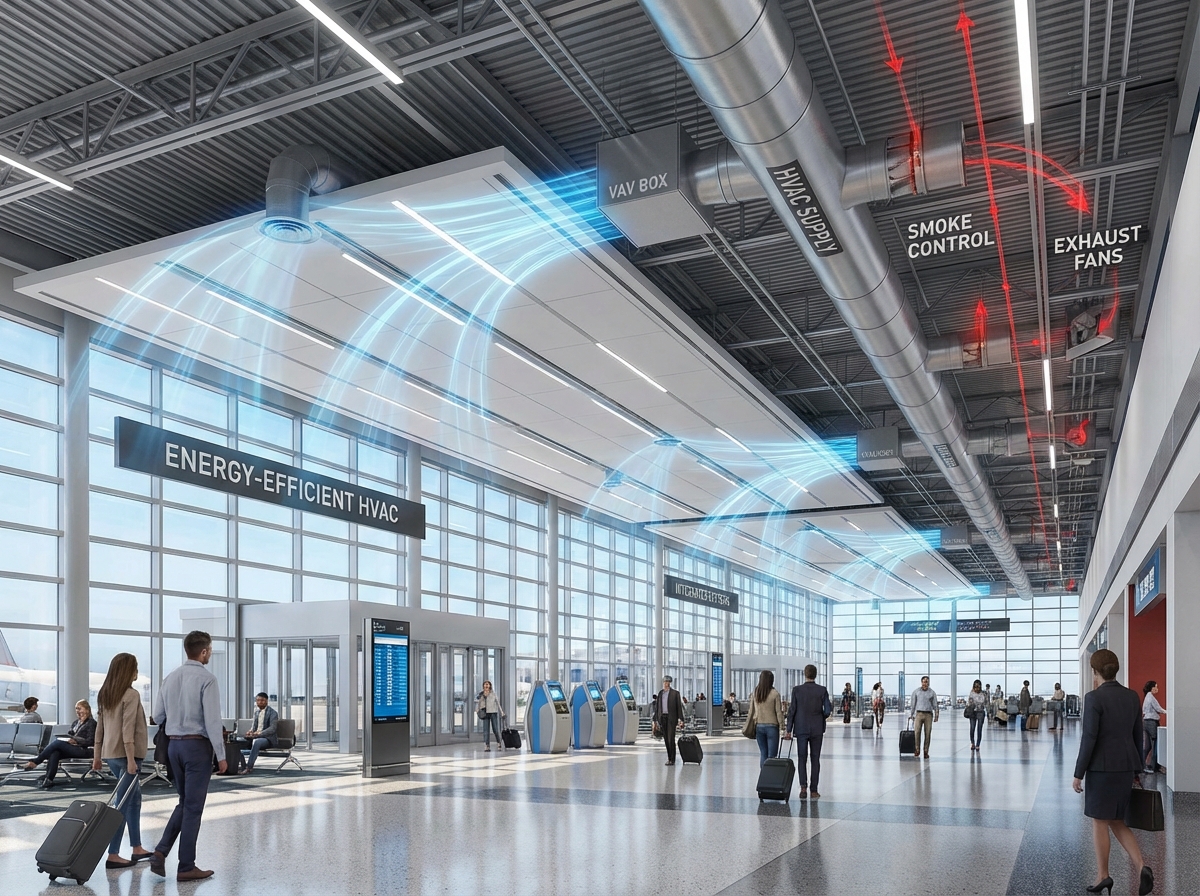
Airport terminals are among the most complex environments for HVAC systems. Large open spaces, high ceilings, and varying occupancy create unique airflow challenges. Efficient HVAC solutions must balance passenger comfort, energy efficiency, and safety compliance.
Modern systems integrate variable airflow, precise temperature control, and emergency ventilation to maintain optimal conditions throughout the terminal.
Key HVAC Considerations
Zoned Air Distribution
Airflow in terminals must adapt to fluctuating passenger density. VAV (Variable Air Volume) systems allow dynamic airflow adjustment, supplying more air to crowded areas like boarding gates while reducing airflow in low-traffic zones.
- Maintains comfortable temperature and humidity
- Reduces unnecessary energy consumption
- Supports long-term operational cost savings
High-Ceiling and Atrium Airflow
Large atriums and concourses require long-throw diffusers to reach occupied zones. Jet nozzle diffusers or linear slot diffusers distribute air evenly while minimizing drafts and temperature stratification.
Fire and Smoke Control Integration
Airports must meet strict fire and smoke safety standards. Fire dampers and smoke control systems are integrated into HVAC networks to:
- Contain smoke in emergency situations
- Maintain safe evacuation pathways
- Ensure minimal system downtime during emergencies
Energy Efficiency in Airport HVAC Systems
Advanced Fan and Control Systems
Energy-efficient fans combined with intelligent control systems adapt airflow to real-time occupancy and load. Features include:
- Variable speed drives for fans
- Automated dampers and zone controllers
- Energy monitoring and optimization
Demand-Controlled Ventilation
CO2 and occupancy sensors allow ventilation rates to adjust automatically. This reduces energy consumption while ensuring air quality for passengers and staff.
Airport-Specific Applications
Boarding Gates and Waiting Areas
- High-efficiency diffusers maintain uniform temperature
- Noise control for passenger comfort
- Flexible airflow patterns for varying occupancy
Baggage Handling and Service Areas
- Targeted airflow to remove heat from machinery
- Fire and smoke dampers integrated in ductwork
- Zone-specific VAV control for energy savings
Retail and Food Courts
- Maintain air quality and comfort for high-traffic commercial zones
- Independent zone controls for after-hours energy reduction
Performance Metrics
Airflow Accuracy
Precise airflow delivery ensures comfort and prevents over-conditioning.
Energy Savings
Optimized VAV and intelligent control reduce fan energy and overall HVAC power usage.
Compliance
All components meet international standards for fire safety, smoke control, and HVAC performance.
Design and Maintenance
System Layout Planning
Design starts with mapping terminal zones, passenger flow, and sensitive areas. Long-throw and directional diffusers are placed for maximum coverage and comfort.
Integration with Safety Systems
Fire and smoke control systems must work seamlessly with HVAC operations, switching instantly from energy-saving to emergency mode.
Long-Term Operation
Accessible components and clear maintenance documentation ensure that HVAC systems maintain energy efficiency and performance throughout the airport’s lifecycle.
FAQ
Why is HVAC critical in airport terminals?
HVAC ensures passenger comfort, air quality, and safe evacuation in emergencies while reducing operational costs.
What makes airport HVAC different from other commercial buildings?
Large volumes, high ceilings, fluctuating occupancy, and strict fire & smoke regulations require specialized airflow and safety systems.
Can energy-efficient HVAC systems maintain safety compliance?
Yes. Modern designs integrate fire dampers and smoke control systems without compromising energy efficiency.
What zones benefit most from VAV in airports?
Boarding gates, waiting areas, retail zones, baggage handling areas, and service corridors benefit from variable airflow control.
About YAOAN Ventilation
YAOAN Ventilation delivers tailored HVAC solutions for international airports, integrating energy-efficient airflow, fire & smoke safety, and operational reliability. With decades of engineering experience, YAOAN ensures stable comfort, regulatory compliance, and cost-effective operation for large transportation hubs.