Table of Contents
ToggleIntroduction: Why Noise Control Matters in Transit Hubs
Airports and subway stations are high-occupancy, high-volume spaces where HVAC noise can directly affect passenger comfort, announcements audibility, and public satisfaction. Effective noise control ensures:
- Clear public announcements and signage
- Comfortable ambient sound levels
- Regulatory compliance with acoustic standards
- Efficient airflow without compromising noise performance
Noise control in large HVAC systems is often overlooked but is critical to user experience and operational efficiency.
Core Sources of HVAC Noise in Transit Spaces
Fan and Motor Noise
High-capacity air handling units (AHUs) and fans generate:
- Tonal noise from motor vibration
- Broadband noise from high-speed fans
- Pulsations from air movement through dampers
Selecting low-noise fans, vibration isolation mounts, and variable-speed drives mitigates these effects.
Ductwork and Airflow-Induced Noise
Noise from duct systems can originate from:
- High velocity airflow through bends or diffusers
- Turbulence at branch connections
- Pressure drop-induced whistling
Proper duct design, turning vanes, and acoustic lining help maintain sound levels within acceptable thresholds.
Diffuser and Grille Noise
Supply and return air outlets can amplify noise:
- Long-throw diffusers in atriums or concourses can create jet noise
- Slot diffusers or linear grilles can produce whistling if air velocity is too high
Careful selection of diffuser type, face velocity, and installation angle reduces occupant discomfort.
Strategies for Effective HVAC Noise Control
Silencers and Acoustic Duct Liners
- In-line silencers absorb high-frequency noise
- Perforated duct liners reduce broadband and tonal noise
- Vibration-damped duct sections minimize mechanical transmission
Fan Selection and Variable-Speed Control
- Low-noise fan blades reduce tonal peaks
- Variable-speed drives allow modulation of airflow without generating excessive noise
- Redundant fan arrays prevent high-speed operation during peak demand
Isolated Air Handling Units
- Mount AHUs on vibration-isolated bases
- Use flexible connectors between units and ductwork
- Separate mechanical rooms from passenger areas when possible
Compliance and Standards
Transit HVAC noise must comply with:
- ASHRAE Handbook – HVAC Applications noise criteria
- Local building acoustic codes for airports and railway stations
- ISO 3741/ISO 11690 standards for sound power levels
Early integration of acoustic engineers into HVAC design ensures regulatory compliance and avoids costly retrofits.
Image Reference (for Blog Integration)
Image Alt Text:
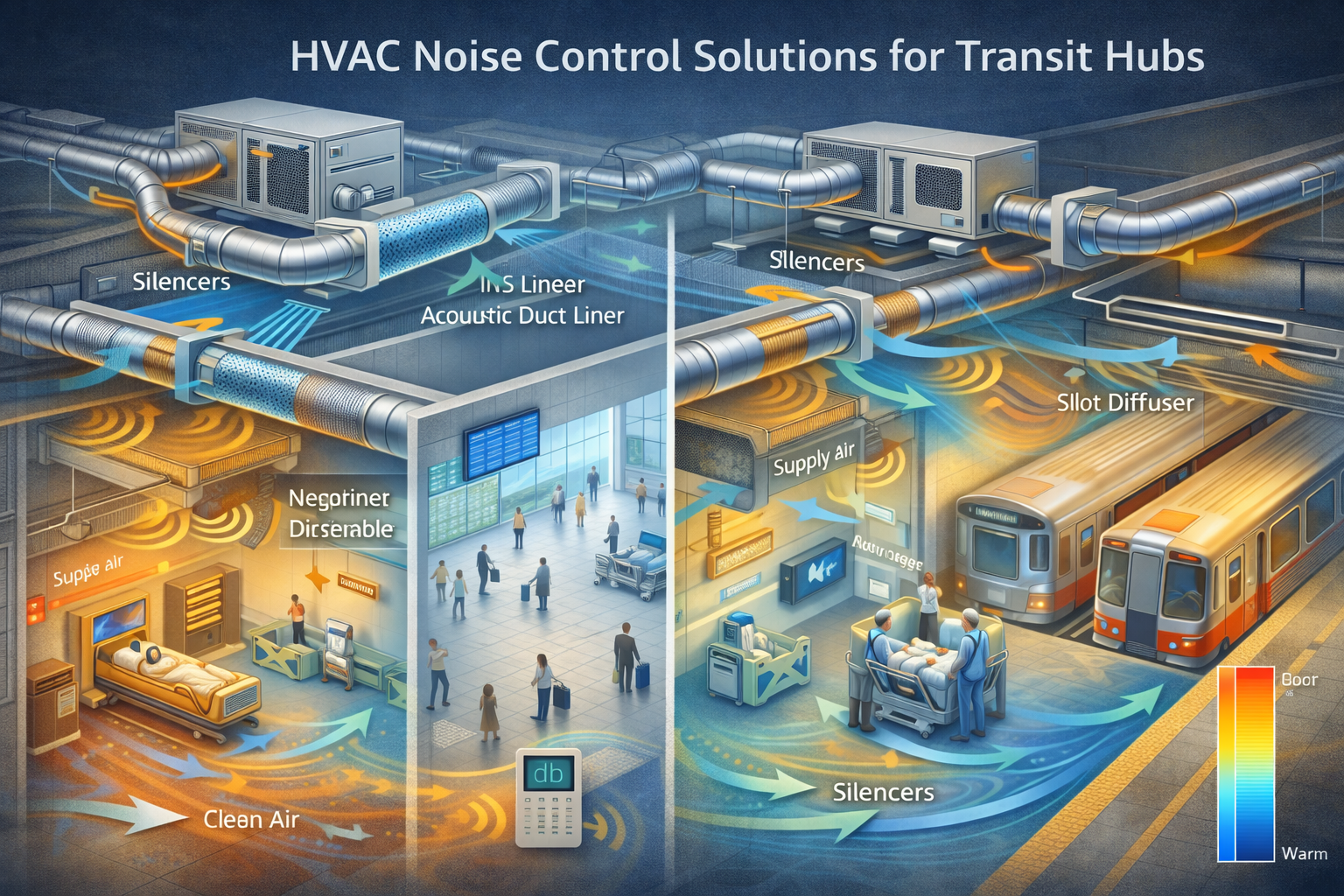
HVAC noise control design in airports and subway stations showing silencers, acoustic duct liners, and vibration-isolated air handling units.
Image Title:
HVAC Noise Control Solutions for Transit Hubs
Energy Considerations
Noise control solutions must also consider energy efficiency:
- Duct liners and silencers can increase pressure drop, affecting fan energy
- Optimize layout and acoustic treatment to balance noise and airflow
- Use computational fluid dynamics (CFD) to model airflow-induced noise before installation
Conclusion: Noise Control as a Critical Comfort Component
Effective HVAC noise control in airports and subway stations:
- Protects passenger experience
- Ensures clear announcements and information delivery
- Enhances staff productivity and reduces complaints
- Maintains operational efficiency while meeting safety and acoustic standards
Transit HVAC design must integrate airflow, energy, and noise considerations from the earliest design stages.
FAQ – HVAC Noise Control in High-Volume Transit Spaces
What are the main causes of HVAC noise in airports and subways?
Fan vibration, high-velocity duct airflow, and diffuser jet noise are the primary sources.
How can noise be reduced without affecting airflow?
Use silencers, duct liners, vibration isolation, and low-velocity diffusers. CFD modeling can optimize airflow and sound performance.
Are there specific standards for HVAC noise in transit hubs?
Yes, ASHRAE Handbook, ISO 3741/11690, and local building codes provide noise criteria for airports and subway stations.
Can variable-speed fans help reduce noise?
Absolutely. Variable-speed fans lower motor and airflow noise during off-peak operation while maintaining comfort and ventilation.