Table of Contents
ToggleUnderstanding Large Building HVAC Challenges
Large commercial or industrial buildings present unique HVAC challenges. High ceilings, extensive floor areas, and diverse occupancy zones require a system that delivers reliable comfort, energy efficiency, and safety compliance.
Key considerations include:
- Variable occupancy levels across zones
- Long air distribution distances
- Fire and smoke control requirements
- Energy efficiency and operational costs
Core Selection Criteria
Building Type and Function
The first step is to analyze the building’s purpose:
- Office towers may prioritize comfort and quiet operation.
- Airports, malls, or convention centers require long-throw airflow and high occupant comfort.
- Data centers and technical facilities need precise temperature and airflow control for equipment safety.
Zoning and Airflow Management
Large buildings benefit from zoning, which allows:
- Independent airflow and temperature control per zone
- Energy savings by avoiding over-conditioning unoccupied areas
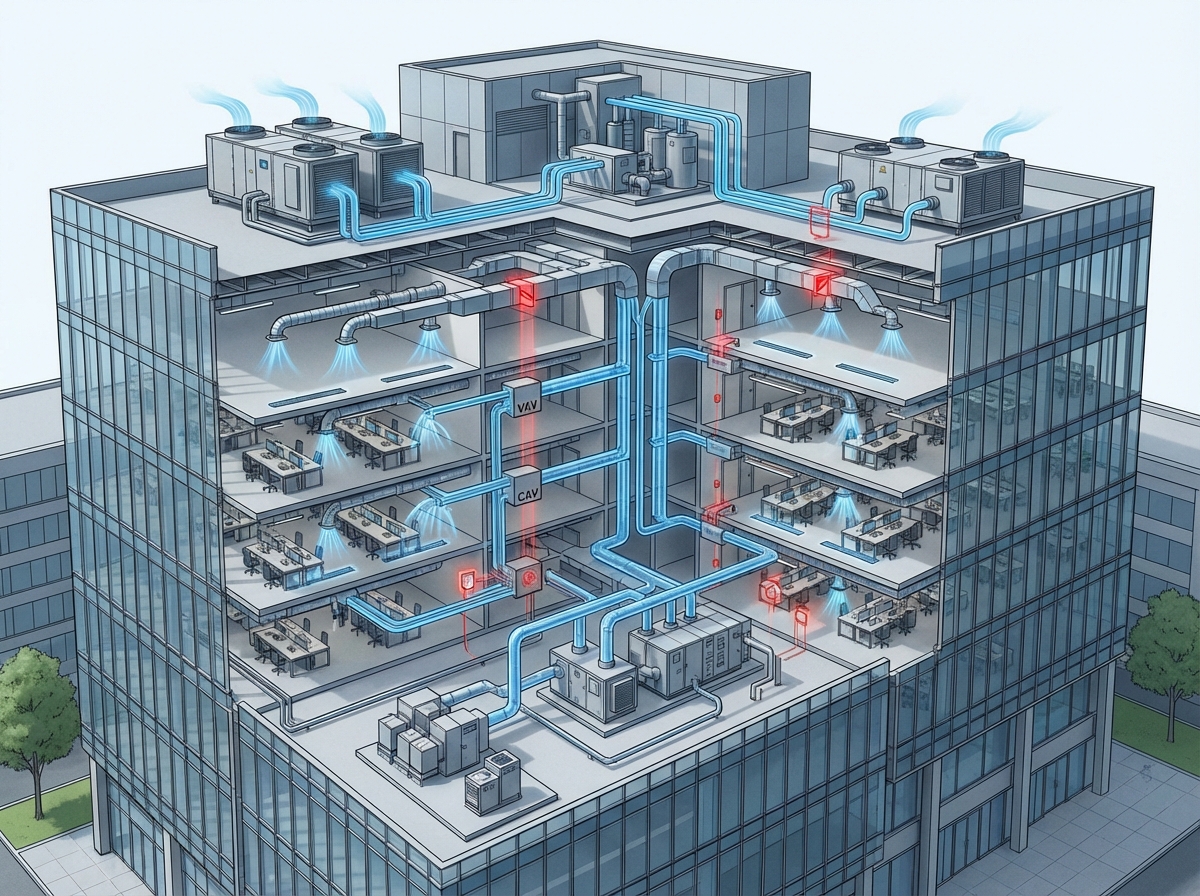
- Integration with variable air volume (VAV) systems or demand-controlled ventilation (DCV)
Energy Efficiency and Sustainability
Modern HVAC selection focuses on energy efficiency:
- High-efficiency fans with variable speed drives
- Smart controls for real-time airflow optimization
- Heat recovery or economizer systems to reduce overall energy usage
Fire and Safety Compliance
Selecting the right system must include fire and smoke safety:
- Fire dampers and smoke control integrated into ductwork
- Compliance with local and international safety codes
- Emergency ventilation sequences coordinated with alarms
Comparing HVAC System Types
Variable Air Volume (VAV) Systems
- Adjust airflow based on demand
- Reduces fan energy usage
- Suitable for offices, airports, and commercial complexes
Constant Air Volume (CAV) Systems
- Delivers uniform airflow at all times
- Simple design but less energy-efficient for large, variable-occupancy spaces
Dedicated Outdoor Air Systems (DOAS)
- Controls humidity and ventilation independently
- Can be paired with VAV or CAV systems for precise control
Hybrid or Customized Systems
- Combine multiple system types for specific requirements
- Can integrate fire and smoke control, energy recovery, and zoning for complex layouts
Design and Installation Considerations
Proper Duct Layout and Diffuser Selection
- Minimize pressure losses
- Use jet nozzle or linear slot diffusers for long-throw and high-ceiling areas
- Ensure airflow reaches occupied zones efficiently
Integration with Building Automation Systems (BAS)
- Real-time monitoring of temperature, airflow, and energy consumption
- Automated control of VAV boxes, dampers, and fans
- Scheduling for energy savings during off-peak periods
Maintenance and Accessibility
- Ensure system components are accessible for inspection and cleaning
- Clear documentation for adjustments, repairs, and upgrades
- Maintain energy efficiency and safety performance over time
Performance Metrics to Evaluate
Airflow and Comfort
- Measured velocity and temperature consistency across zones
- Avoid drafts, stratification, or uneven heating/cooling
Energy Consumption
- Fan power, cooling/heating load, and control system efficiency
- Annual energy cost vs capital cost balance
Safety Compliance
- Fire damper and smoke control performance
- Emergency mode operation and alarm integration
FAQ
How do I know if my building needs VAV or CAV?
VAV is recommended for large buildings with variable occupancy, as it reduces energy consumption. CAV may suffice for smaller or uniformly occupied areas.
Should I consider hybrid systems?
Yes, hybrid systems combine multiple technologies to meet energy, airflow, and safety requirements in complex layouts.
How important is fire and smoke integration in HVAC selection?
Critical. Systems must comply with local safety codes and provide emergency airflow sequences to protect occupants and infrastructure.
Can building automation improve HVAC efficiency?
Absolutely. Real-time control of airflow, temperature, and fan speed reduces energy use while maintaining comfort and safety.
About YAOAN Ventilation
YAOAN Ventilation provides engineered HVAC solutions for large commercial, industrial, and public buildings. From system selection to installation, integration, and maintenance, YAOAN ensures energy-efficient airflow, zoning control, and fire & smoke compliance for optimal building performance.