Table of Contents
ToggleIntroduction
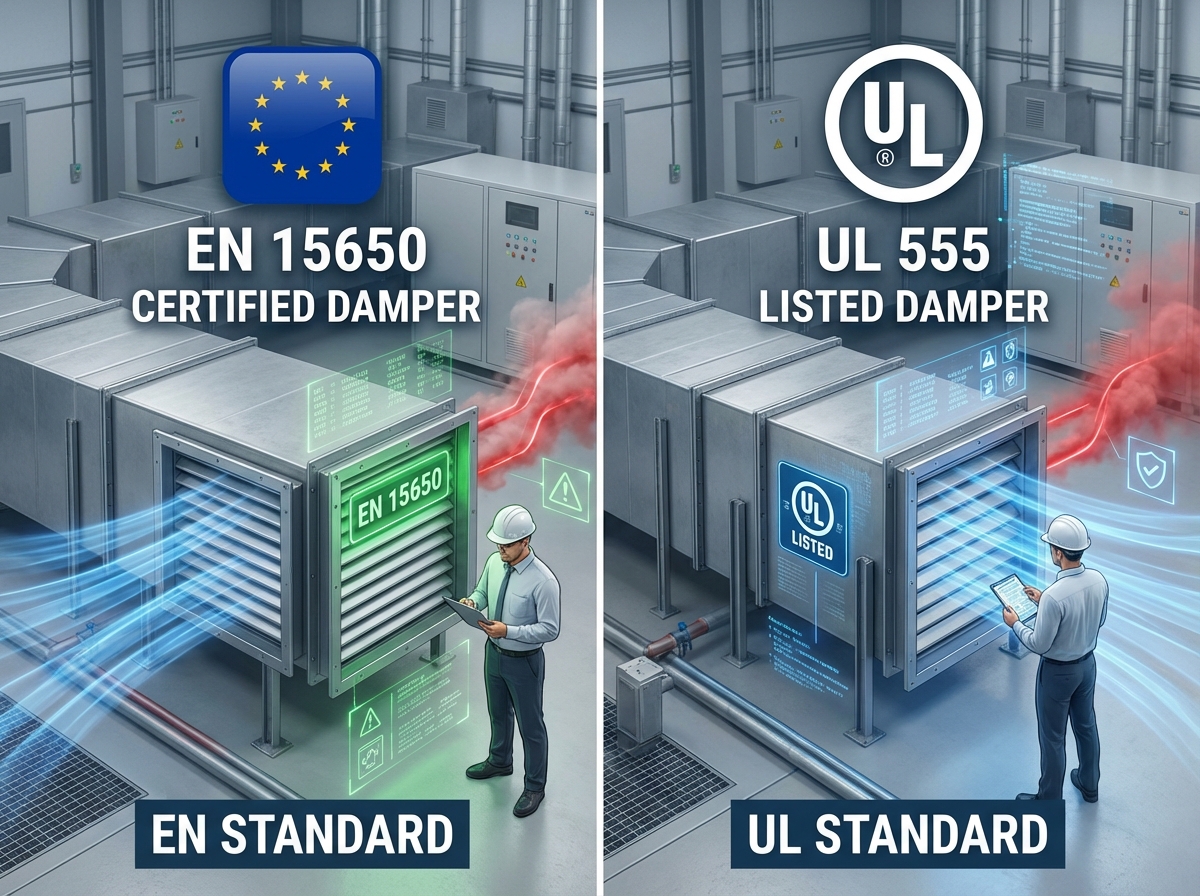
Fire dampers are critical HVAC components that prevent the spread of fire and smoke through ventilation systems. EN (European Norms) and UL (Underwriters Laboratories) provide internationally recognized standards for testing and performance, but their approaches differ significantly. Understanding these differences is essential for engineers, contractors, and building owners working on international projects.
YAOAN Ventilation offers fire dampers and related solutions that meet both EN and UL standards for global compliance.
Key Differences Between EN and UL Standards
Scope and Regional Focus
- EN Standards: Primarily European, covering product design, installation, and performance under European building codes.
- UL Standards: Primarily North American, widely recognized internationally, focusing on safety, fire resistance, and operational reliability.
Testing Procedures
- EN 1366-2 / EN 15650:
- Fire dampers are tested under both temperature and airflow conditions.
- Emphasis on European fire resistance classes (E, EI).
- UL 555 / UL 555S:
- Fire dampers are tested for closure at high temperatures.
- Smoke dampers tested separately under UL 555S standards.
- Emphasis on North American fire ratings (1h, 1.5h, 3h).
Installation Requirements
- EN Standards: Focus on integration into European duct systems, wall/ceiling penetrations, and compliance with EN-certified installation manuals.
- UL Standards: Focus on adherence to UL-listed installation procedures, inspection by authorities having jurisdiction (AHJ), and mechanical integrity.
Certification and Documentation
- EN-certified dampers: Documented according to European CE marking and product declarations.
- UL-listed dampers: Include UL labels, test reports, and compliance certificates recognized in US and international markets.
Best Practices for International Projects
Product Selection
- Determine project location and applicable code (EN or UL).
- Choose dampers that meet the required standard for fire rating and airflow performance.
Coordination with Design Teams
- Integrate dampers with HVAC layout, fire alarm, and smoke control systems.
- Use BIM or CFD simulations to verify airflow and safety performance.
Testing and Maintenance
- Conduct factory acceptance testing (FAT) and site acceptance testing (SAT) per relevant standards.
- Schedule regular inspections to maintain compliance and operational reliability.
FAQ
What is the main difference between EN and UL fire damper standards?
EN focuses on European fire classes and integrated performance under airflow, while UL emphasizes high-temperature closure, smoke control, and North American fire ratings.
Can a fire damper meet both EN and UL standards?
Yes, some dampers are designed and tested to comply with both EN and UL standards for international projects.
Why is it important to know the differences?
Selecting dampers according to the correct standard ensures regulatory approval, occupant safety, and reliable fire protection.
Does YAOAN provide fire dampers for both standards?
Yes, YAOAN offers EN-certified and UL-listed fire dampers, providing solutions for global compliance in commercial and industrial projects.
About YAOAN Ventilation
YAOAN Ventilation provides fire damper solutions that comply with EN and UL standards. Our portfolio includes fire and smoke dampers, control systems, and integrated HVAC components designed for international projects. YAOAN ensures safety, compliance, and reliable performance across commercial buildings, industrial facilities, and infrastructure worldwide.