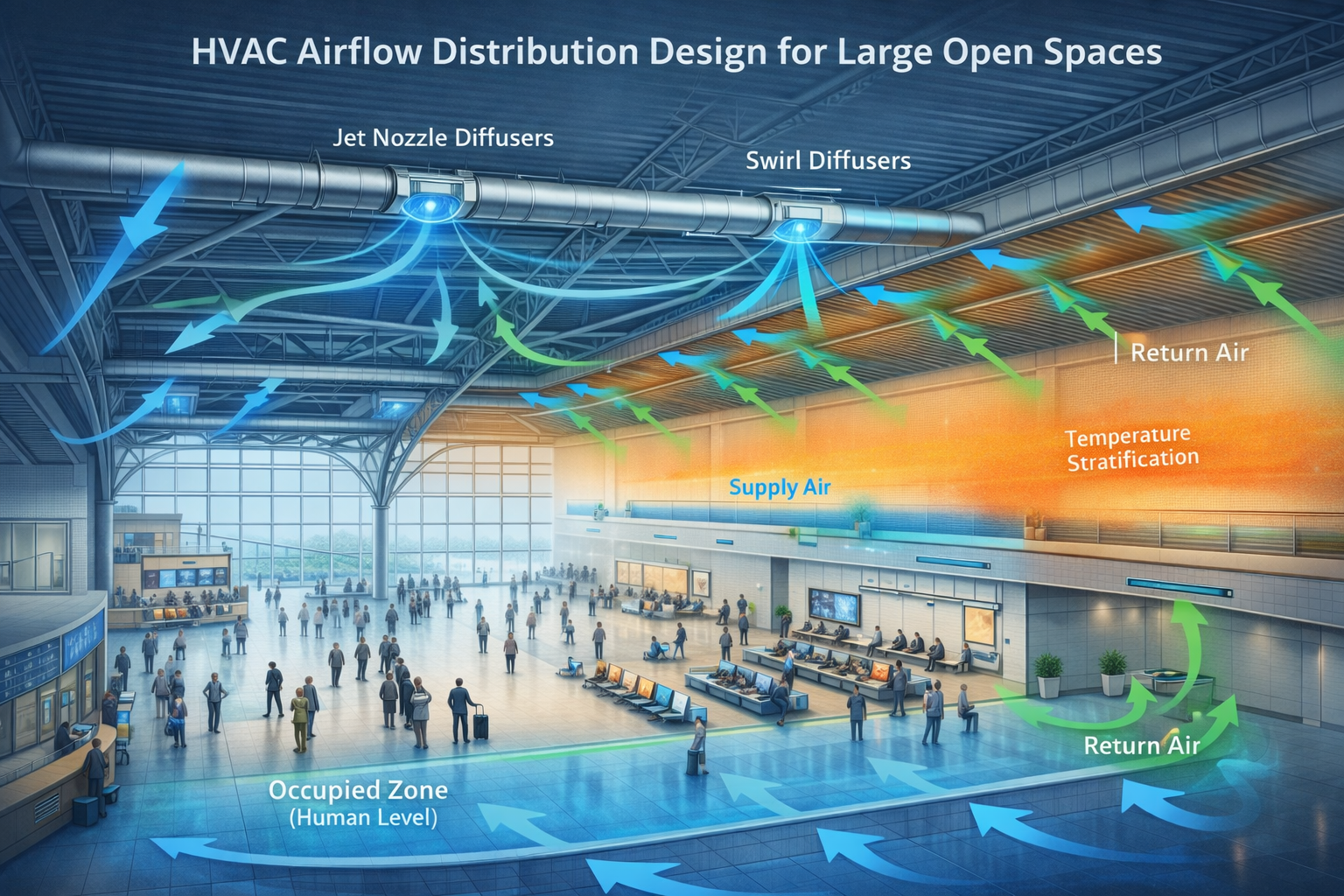
Large open spaces such as airport terminals, exhibition halls, shopping malls, atriums, and industrial bays present unique challenges for HVAC airflow distribution. High ceilings, long distances, variable occupancy, and architectural constraints often cause conventional air distribution methods to underperform.
Effective airflow distribution design focuses on delivering conditioned air precisely to the occupied zone while maintaining thermal comfort, energy efficiency, and compliance with international standards. For architects, HVAC engineers, and B2B project owners, airflow strategy is a system-level decision rather than a diffuser-level choice.
Table of Contents
ToggleWhy Airflow Distribution Is Critical in Large Open Spaces
In large-volume buildings, air behaves differently than in standard office environments. Poor airflow design can result in stratification, dead zones, drafts, and excessive energy consumption.
Key challenges include:
- Supply air failing to reach the occupied zone
- Hot or cold air accumulating at roof level
- Uneven temperature distribution across large floor areas
- Difficulty balancing comfort, noise, and energy efficiency
A well-designed airflow distribution system addresses these issues through controlled throw, induction, and return-air coordination.
Core Principles of Airflow Design in High-Volume Spaces
Focus on the Occupied Zone, Not the Ceiling
The primary goal is to condition the occupied zone—typically the area below 2 meters—rather than the full building volume. Airflow paths must be planned to ensure usable air reaches people, not just architectural voids.
Design considerations include:
- Terminal air velocity limits for comfort
- Acceptable temperature gradients from floor to ceiling
- Avoidance of direct drafts on occupants
Long-Throw and High-Induction Air Supply
Standard ceiling diffusers often lack the throw required for tall or deep spaces. High-induction devices such as jet nozzle diffusers, swirl diffusers, or displacement outlets help move air over longer distances and promote mixing.
These solutions:
- Maintain airflow momentum over large spans
- Induce surrounding air to improve mixing
- Reduce stratification and temperature layering
Common Air Distribution Strategies for Large Open Spaces
Jet-Based Air Distribution
Jet nozzles and long-throw diffusers are commonly used in:
- Airport halls
- Large atriums
- Exhibition and convention centers
They are typically installed on high walls or structural beams and aimed toward occupied zones. Proper selection of airflow rate, throw distance, and discharge angle is essential to avoid noise or drafts.
Stratified and Displacement Ventilation
In spaces with predictable occupancy and heat loads, displacement ventilation can be effective. Low-velocity air is supplied near the floor, allowing heat sources to drive upward airflow naturally.
This approach:
- Improves indoor air quality
- Reduces fan energy consumption
- Works best with controlled heat sources and ceiling heights
Zoning and Variable Air Volume Control
Large open spaces rarely operate under uniform conditions. Zoning combined with VAV control allows airflow to respond to real occupancy and load variations.
Benefits include:
- Improved energy efficiency
- Better temperature control across zones
- Reduced over-ventilation during low occupancy
Coordination of Supply and Return Air
Airflow distribution design is incomplete without return-air planning. Poorly placed returns can short-circuit supply air or trap heat at high levels.
Best practices include:
- Positioning return grilles to support full-room circulation
- Using high-level returns to manage stratification
- Coordinating smoke exhaust paths in fire scenarios
In large public buildings, airflow design often overlaps with smoke control and fire safety strategies.
Engineering Considerations for Design and Commissioning
Acoustic and Pressure Control
Long-throw airflow devices require higher velocities, which can increase noise if improperly selected. Engineers must balance:
- Sound pressure levels
- Static pressure losses
- Fan energy consumption
CFD and Performance Verification
For complex geometries, CFD simulations help visualize airflow behavior and validate design assumptions. Post-installation commissioning ensures the system performs as intended under real conditions.
Airflow Distribution as a System-Level Decision
Airflow distribution in large open spaces is not a product selection exercise—it is a system-level design decision that integrates architecture, structure, HVAC equipment, controls, and operational strategy.
When designed correctly, effective airflow distribution:
- Enhances occupant comfort
- Improves energy performance
- Supports compliance with EN, ASHRAE, and fire safety standards
- Reduces long-term operating costs
FAQ (Schema-Ready)
What is airflow distribution in HVAC design?
Airflow distribution refers to how conditioned air is supplied, mixed, and returned within a space to achieve comfort, air quality, and energy efficiency.
Why is airflow design more difficult in large open spaces?
High ceilings, long distances, and uneven occupancy cause air stratification and uneven temperatures if standard solutions are used.
Which diffusers are suitable for large open spaces?
Jet nozzle diffusers, swirl diffusers, displacement outlets, and long-throw diffusers are commonly used depending on space geometry and usage.
How does airflow distribution affect energy efficiency?
Poor airflow leads to over-conditioning and wasted energy. Proper distribution targets only the occupied zone, reducing load and fan energy.
Is CFD necessary for large-space HVAC design?
While not mandatory, CFD is highly recommended for complex spaces to validate airflow paths and comfort levels before construction.