Table of Contents
ToggleIntroduction: Challenges in Mixed-Use Developments
Mixed-use developments combine residential, commercial, retail, and public spaces, presenting unique challenges:
- Varying occupancy loads
- Different fire safety and ventilation requirements per zone
- Complex ductwork and smoke control integration
Effective coordination ensures occupant safety, fire code compliance, and energy-efficient HVAC performance.
Key Coordination Strategies
Zoning and System Separation
- Separate HVAC systems per building function (residential, office, retail)
- Ensure fire-rated barriers between zones
- Prevent cross-contamination of smoke or pollutants
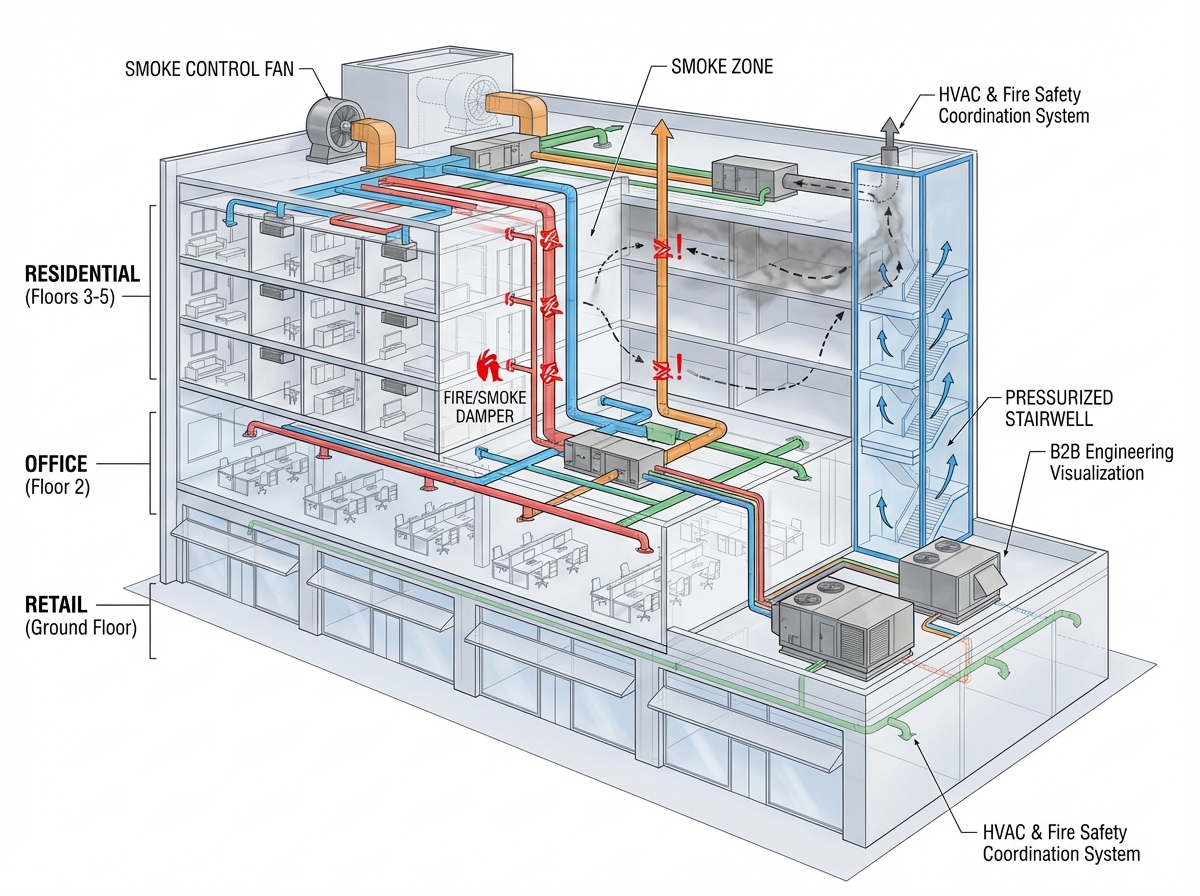
Fire and Smoke Dampers Integration
- Install EN / UL certified fire and smoke dampers at HVAC penetrations
- Dampers automatically close during fire events to contain smoke and fire
- Coordinate damper locations with HVAC airflow paths to maintain ventilation performance
Smoke Control and Extraction
- Use pressurized stairwells and corridors to ensure safe egress
- Implement zoned smoke extraction fans for commercial and public areas
- CFD simulations help predict smoke movement and optimize fan placement
Controls and Automation
- Integrate fire alarm systems with building management (BMS)
- Automatically adjust fan speed, damper position, and airflow during emergencies
- Ensure normal HVAC operation is unaffected in non-affected zones
Compliance with Standards
- NFPA 92 for smoke control
- NFPA 90A / EN 12101 for fire-rated HVAC systems
- Local building and fire codes for mixed-use occupancy
Image Reference (for Blog Integration)
Image Alt Text:
Mixed-use building HVAC and fire safety coordination showing fire dampers, smoke control fans, and airflow paths.
Image Title:
Fire and HVAC Coordination in Mixed-Use Developments
Conclusion: Balancing Safety and HVAC Performance
Effective fire and HVAC coordination in mixed-use buildings ensures:
- Life safety for all occupants
- Smoke containment and controlled egress
- Energy-efficient ventilation and uninterrupted comfort
YAOAN provides engineered solutions combining fire-rated dampers, smoke extraction systems, and automated HVAC control for complex mixed-use developments.
FAQ – Fire and HVAC Coordination
Why is coordination important in mixed-use buildings?
Multiple occupancy types create differing fire and ventilation requirements. Coordination ensures safety without compromising airflow efficiency.
How are fire dampers integrated with HVAC?
Fire dampers are installed at duct penetrations through fire-rated barriers. They close automatically during a fire to prevent smoke spread.
What role does automation play?
Building automation systems (BMS) adjust fans, dampers, and airflow dynamically, ensuring safety and uninterrupted operation in unaffected zones.