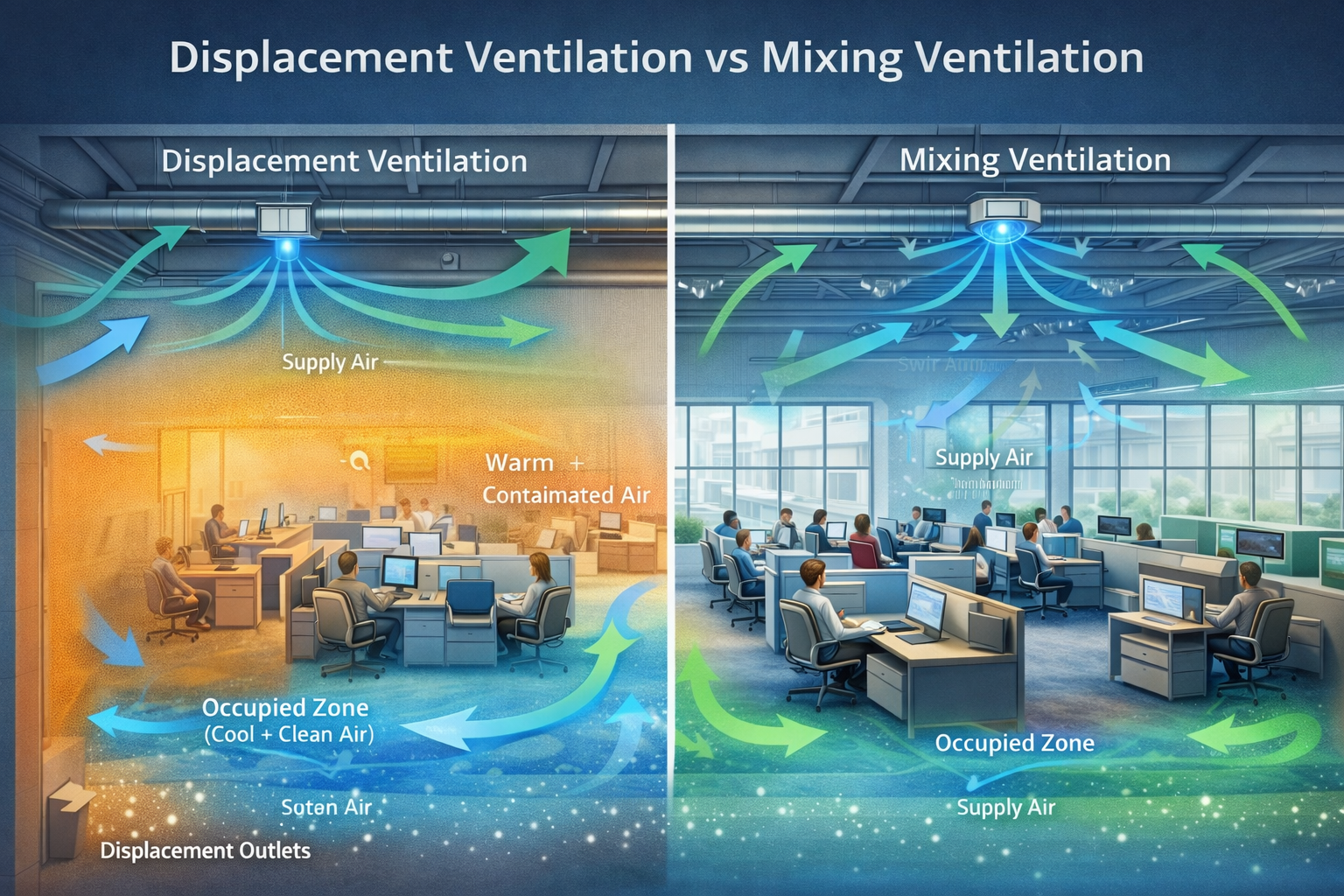
Air distribution strategy has a direct impact on thermal comfort, indoor air quality, and HVAC system efficiency—especially in large-volume and high-occupancy buildings. Among the most commonly specified approaches, displacement ventilation and mixing ventilation represent two fundamentally different airflow philosophies.
Understanding how each system behaves in real buildings allows HVAC engineers and designers to select the most appropriate solution based on space geometry, load profile, and performance targets.
Table of Contents
ToggleFundamentals of Air Distribution in Buildings
Air distribution is not only about delivering airflow volume. It determines how heat, contaminants, and fresh air interact within the occupied zone.
Two core questions drive system selection:
- How does supplied air move through the space?
- Where do heat and pollutants accumulate or exit?
Displacement and mixing systems answer these questions in very different ways.
How Displacement Ventilation Works
Displacement ventilation supplies air at low velocity and slightly lower temperature directly into the occupied zone, typically at floor level or through low-wall diffusers.
Cool supply air spreads across the floor, absorbs heat from occupants, equipment, and lighting, then rises naturally through buoyancy effects. Warm and contaminated air accumulates at higher levels and is exhausted near the ceiling.
This creates a vertical stratification profile, with cleaner, cooler air where people are located.
Airflow Characteristics of Displacement Systems
Key airflow behaviors include:
- Minimal turbulence in the occupied zone
- Vertical temperature gradient from floor to ceiling
- Pollutants transported upward rather than mixed
Because airflow relies heavily on thermal plumes, displacement ventilation performs best when internal heat loads are stable and predictable.
Typical Applications for Displacement Ventilation
Displacement ventilation is commonly used in:
- Airport terminals and waiting halls
- Theaters and auditoriums
- Office buildings with high ceilings
- Educational buildings and libraries
- Industrial spaces with localized heat sources
High ceiling height is critical, as it provides space for warm air stratification above occupants.
How Mixing Ventilation Works
Mixing ventilation aims to uniformly distribute air temperature and contaminants throughout the entire room volume.
Air is supplied at higher velocity from ceiling diffusers, jet nozzles, or swirl diffusers. The induced turbulence rapidly mixes supply air with room air, minimizing temperature and concentration differences.
The occupied zone experiences relatively uniform conditions regardless of location.
Airflow Characteristics of Mixing Systems
Mixing ventilation is defined by:
- High induction and turbulence
- Limited vertical temperature gradient
- Even distribution of heat and pollutants
Because mixing ventilation does not rely on buoyancy, it is less sensitive to load variation and occupant movement.
Typical Applications for Mixing Ventilation
Mixing ventilation remains the dominant solution in:
- Commercial offices
- Hospitals and healthcare facilities
- Retail spaces and shopping malls
- Hotels and residential towers
- Data centers with high air change rates
It offers flexibility across diverse layouts and usage patterns.
Thermal Comfort Comparison
Displacement ventilation can provide excellent comfort at lower supply air volumes, but only within strict design limits. Excessive cooling loads or incorrect diffuser placement may cause cold drafts at floor level.
Mixing ventilation delivers consistent comfort across the space, though it may require higher airflow rates to maintain acceptable conditions.
Indoor Air Quality Performance
Displacement ventilation often achieves superior indoor air quality by:
- Removing contaminants upward
- Reducing cross-contamination between occupants
Mixing ventilation dilutes pollutants rather than directing them, which can be effective but less targeted in high-density environments.
Energy Efficiency Considerations
Displacement ventilation can reduce energy consumption by:
- Allowing higher supply air temperatures
- Lowering fan power due to reduced air velocity
However, it is sensitive to ceiling height and load distribution.
Mixing ventilation typically consumes more fan energy but offers predictable performance across operating conditions.
Design and Coordination Challenges
Displacement systems require:
- Careful diffuser placement
- Strict control of supply air temperature
- Coordination with architectural finishes and floor layouts
Mixing systems demand:
- Noise control at higher velocities
- Accurate diffuser selection to avoid drafts
- Balanced return air strategies to prevent short-circuiting
Selecting the Right Strategy for Your Project
The decision between displacement and mixing ventilation should consider:
- Ceiling height and room volume
- Occupancy density and behavior
- Internal heat load distribution
- Flexibility requirements over the building lifecycle
- Fire and smoke control integration
In many large projects, hybrid approaches are also used, combining displacement principles in public areas with mixing systems in enclosed zones.
The Role of Ventilation Components
Regardless of strategy, system performance depends on properly selected components:
- Diffusers and air terminals
- Fire dampers and smoke control devices
- VAV or CAV air volume regulation
- Duct design and pressure control
Reliable airflow control ensures that the intended ventilation concept performs as designed.
FAQ Schema Content
What is the main difference between displacement and mixing ventilation?
Displacement ventilation supplies low-velocity air at floor level and relies on buoyancy, while mixing ventilation supplies high-velocity air from above to create uniform conditions.
Which system is more energy efficient?
Displacement ventilation can be more energy efficient in high-ceiling spaces with stable loads, while mixing ventilation offers consistent performance across varied conditions.
Is displacement ventilation suitable for all buildings?
No. It requires sufficient ceiling height and controlled heat loads to maintain stable stratification.
Why is mixing ventilation still widely used?
Mixing ventilation is flexible, easy to control, and compatible with most building layouts and HVAC standards.
Image Alt Text
Displacement ventilation and mixing ventilation airflow patterns in a large commercial building.
Image Title
Displacement Ventilation vs Mixing Ventilation Airflow Comparison
About YAOAN Ventilation
YAOAN Ventilation provides engineered airflow and ventilation solutions for complex buildings and infrastructure projects. With decades of experience in HVAC systems, fire protection, and airflow control, YAOAN supports designers and engineers in achieving stable comfort, compliance, and long-term operational efficiency across airports, metros, public buildings, and large commercial developments.