Table of Contents
ToggleManaging Airflow in Mission-Critical Buildings
Airports and data centers represent two of the most demanding HVAC environments. Both operate continuously, serve large or sensitive populations, and require stable indoor conditions under variable loads. Inefficient airflow control in these facilities leads directly to higher energy costs, operational risks, and reduced system reliability.
Energy-efficient HVAC systems address these challenges by optimizing airflow delivery, adapting to real-time demand, and integrating safety functions without compromising performance.
HVAC Challenges in Airports and Data Centers
Large volumes and fluctuating occupancy
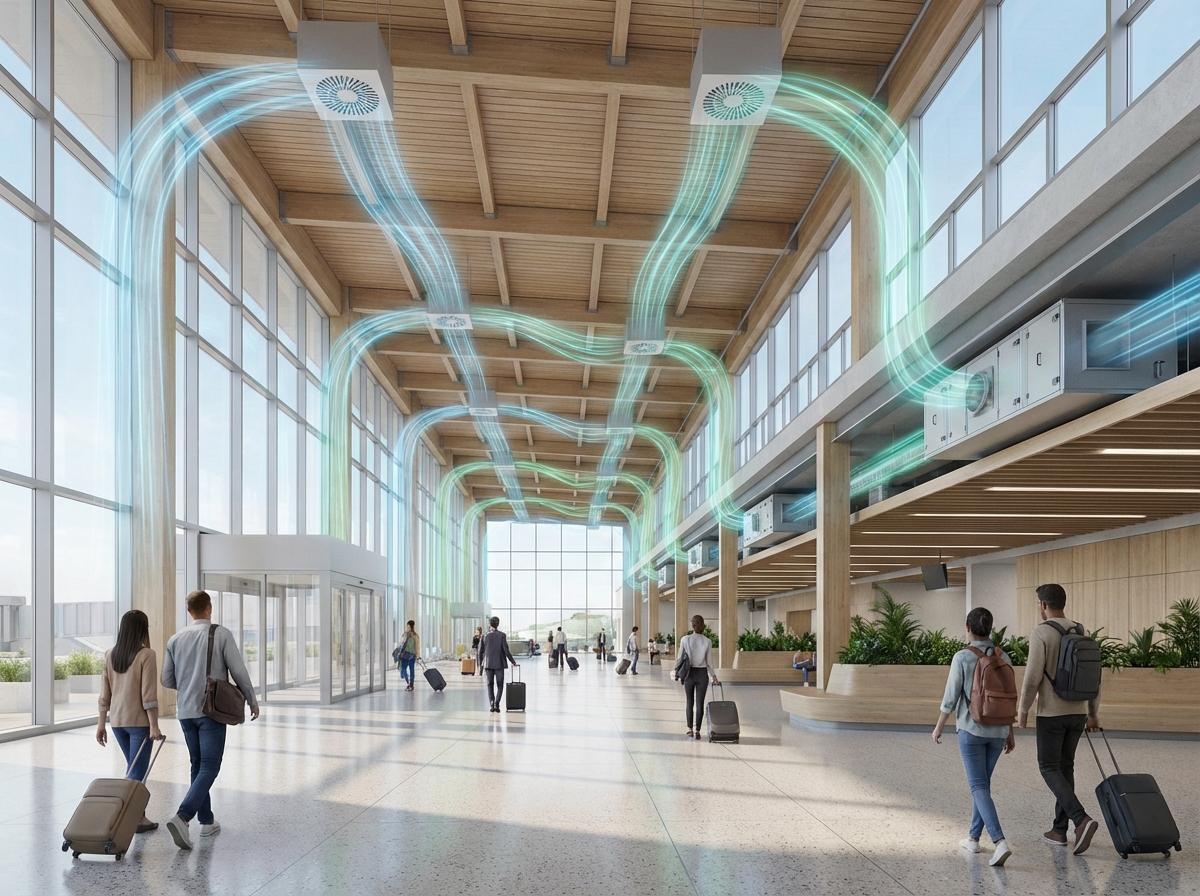
Airport terminals include vast halls, boarding gates, retail areas, and baggage zones. Occupancy varies sharply by time of day and flight schedules. Supplying constant airflow to all areas wastes energy and creates uneven comfort conditions.
Data centers, while more compact, experience load changes driven by IT utilization. Cooling demand shifts between zones, racks, and halls, requiring precise airflow control rather than uniform distribution.
Continuous operation and reliability requirements
Both facilities operate 24/7. HVAC downtime is not acceptable. Systems must maintain efficiency at part load while remaining stable and predictable under peak conditions.
Core Elements of Energy-Efficient HVAC Design
Variable airflow systems and zoning
Variable Air Volume (VAV) systems and intelligent zoning allow airflow to match actual demand. In airports, different terminal zones receive airflow based on occupancy and heat gains. In data centers, airflow can be directed precisely to high-density equipment zones.
This approach significantly reduces fan energy consumption and avoids over-conditioning low-demand areas.
High-efficiency fans and airflow paths
Optimized fan selection and clear airflow paths reduce pressure losses across the system. Efficient fans operating under variable speed control deliver the required airflow with lower energy input and reduced mechanical stress.
Proper duct layout, diffuser placement, and return air strategy ensure stable circulation without short-circuiting or dead zones.
Fire and smoke control integration
Fire dampers and smoke control systems are critical in both airports and data centers. HVAC systems must shift from energy-saving operation to safety mode instantly during emergency events.
Effective integration ensures compartmentation, smoke containment, and compliance with international fire safety standards without compromising daily efficiency.
Application-Specific Considerations
Airport terminals and transportation hubs
In airport environments, HVAC systems must support comfort across large open spaces while controlling temperature gradients between floor and ceiling levels. Energy-efficient designs focus on:
- Zoned airflow for gates, lounges, and retail areas
- Long-throw air distribution for atriums and halls
- Demand-based ventilation aligned with passenger flow
These strategies reduce operating costs while maintaining passenger comfort.
Data centers and technical facilities
Data centers require strict thermal control and airflow stability. Energy-efficient HVAC solutions emphasize:
- Controlled supply and return airflow to prevent hot spots
- Separation of hot and cold air paths
- Precise control of airflow volume rather than excessive cooling
Optimized airflow management improves cooling efficiency and supports higher equipment density.
Performance Factors That Drive Efficiency
Airflow control accuracy
Accurate control at low airflow levels is essential for energy savings. Poor control leads to oscillation, overcooling, or wasted fan energy.
Pressure management and leakage reduction
Maintaining appropriate duct pressure and minimizing leakage improves system efficiency and reduces fan workload.
Noise and operational stability
In airports, acoustic performance affects passenger experience. In data centers, vibration and instability can affect sensitive equipment. Energy-efficient systems balance airflow performance with noise and mechanical stability.
Design and Operational Strategy
Aligning HVAC design with real operating patterns
Energy efficiency depends on how systems are used, not just how they are designed. Flight schedules, passenger flow, and IT load profiles should inform zoning and control strategies.
Seasonal and load-based optimization
HVAC systems must adapt to seasonal changes and varying loads without manual intervention. Automated control logic ensures efficiency throughout the year.
Maintenance and long-term performance
Accessible components, clear documentation, and periodic system tuning help preserve energy performance over the facility’s lifecycle.
FAQ
Why is energy-efficient HVAC critical for airports?
Airports operate continuously and serve large, fluctuating populations. Efficient HVAC systems reduce operating costs while maintaining comfort and safety.
How does airflow control improve data center efficiency?
Precise airflow control delivers cooling only where needed, reducing fan energy and preventing hot spots without excessive cooling.
Can one HVAC approach serve both airports and data centers?
While requirements differ, both benefit from variable airflow, zoning, and integrated safety systems designed around real demand.
Do energy-efficient HVAC systems still meet fire safety requirements?
Yes. Fire dampers and smoke control systems ensure full compliance while allowing efficient operation during normal conditions.
About YAOAN Ventilation
YAOAN Ventilation provides engineered HVAC and airflow management solutions for airports, data centers, and other mission-critical facilities. With expertise in energy-efficient ventilation, fire dampers, airflow control, and system integration, YAOAN supports reliable operation, regulatory compliance, and long-term energy optimization.