Table of Contents
ToggleEnsuring Fire Safety and Airflow in Hospitals
Hospitals have unique challenges: patient safety, critical equipment, and controlled airflow are essential. Fire and smoke in a healthcare facility can be catastrophic.
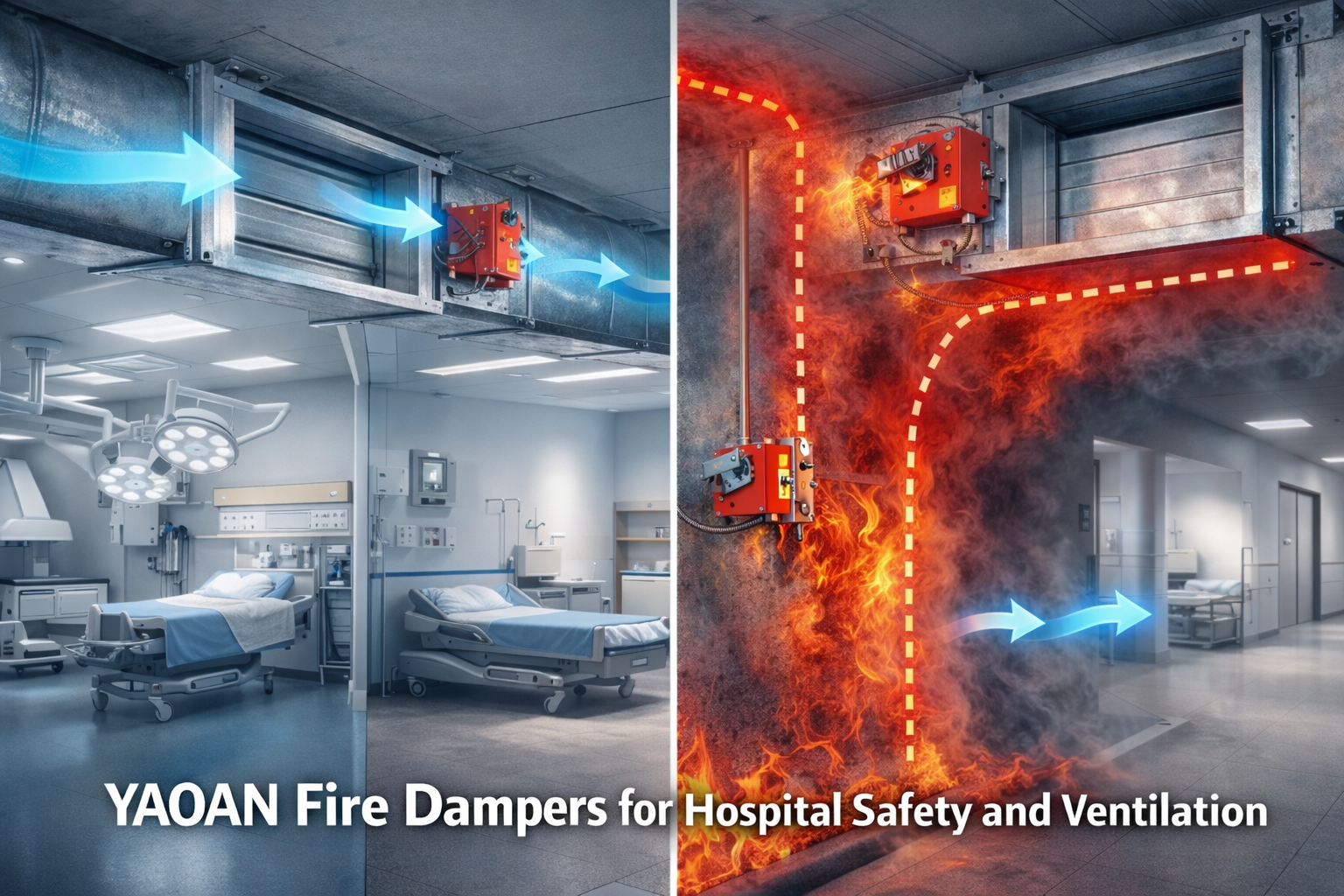
YAOAN Fire Dampers automatically seal HVAC ducts during fire events, preventing smoke and flames from spreading while maintaining normal airflow under safe conditions. These systems are crucial for protecting patients, staff, and sensitive hospital equipment.
How YAOAN Fire Dampers Work in Healthcare Facilities
Automatic Heat-Activated Closure
YAOAN fire dampers feature fusible links or thermal elements that trigger at a specific temperature:
- Damper blades close to isolate fire zones
- Smoke and flames are contained within the HVAC system
- Compliant with UL, EN, and NFPA standards
Flexible Installation Across Hospital Zones
YAOAN dampers can be installed in:
- Horizontal and vertical ducts
- Operating rooms, ICUs, patient rooms, labs, and pharmacies
- Emergency ventilation shafts for smoke extraction
Applications in Hospitals
Operating Rooms and ICUs
In critical areas, fire dampers:
- Prevent smoke from entering sterile zones
- Maintain positive pressure airflow where required
- Ensure continuous patient safety during fire events
Corridors, Lobbies, and Patient Rooms
In public and patient areas, dampers:
- Isolate smoke to protect evacuation paths
- Integrate with HVAC to maintain normal comfort
- Work with smoke control fans and alarm systems
Key Performance Considerations
Temperature Rating and Airflow
Engineers must consider:
- Activation temperature to ensure rapid closure
- Duct size and airflow volumes in hospital HVAC systems
- Fire-resistance rating (1–3 hours depending on code)
H3: Noise and Pressure Impact
Although primarily safety devices, fire dampers affect airflow:
- Evaluate static pressure drop at design airflow
- Confirm sound levels do not disturb patient care
Integration with Smoke and HVAC Systems
YAOAN dampers work with:
- Smoke detection systems
- Emergency exhaust and HVAC control sequences
- Central building management systems for monitoring
Design and Maintenance Best Practices
Aligning Fire Dampers with Hospital Layout
- Identify critical areas and high-risk zones
- Isolate fire and smoke without affecting patient comfort
- Maintain clear evacuation routes
Compliance and Safety Standards
- Tested to UL, EN, NFPA standards
- Integration with emergency alarms and smoke extraction
- Seasonal and emergency operational considerations
Long-Term Reliability
- Safe access for inspection and maintenance
- Durable operation for years of service
- Accurate O&M documentation for compliance
FAQ
Q1: What is a fire damper in a hospital?
A fire damper is a device in HVAC ducts that prevents fire and smoke from spreading, protecting patients and staff while allowing normal airflow under safe conditions.
Q2: Why are fire dampers critical in hospitals?
Hospitals have high-risk areas with patients and sensitive equipment. Fire dampers isolate smoke, ensuring evacuation paths and sterile zones remain safe.
Q3: Do YAOAN hospital fire dampers affect airflow?
No. Dampers remain open under normal conditions, maintaining HVAC efficiency and patient comfort.
Q4: Can dampers integrate with hospital smoke control?
Yes. They coordinate with smoke fans, emergency exhaust, and building management systems for controlled smoke management.
About YAOAN Ventilation
YAOAN Ventilation has nearly 30 years of experience providing airflow and fire safety solutions. Since 1996, YAOAN has supplied industrial-grade fire dampers, fans, smoke-control components, and precision ventilation products for hospitals, high-rise buildings, and industrial facilities.
With proper damper selection and system design, YAOAN ensures hospitals maintain safe airflow, fire compliance, and reliable emergency performance, protecting patients, staff, and critical healthcare operations.