Table of Contents
ToggleAxial Fans in the Ventilation Toolbox
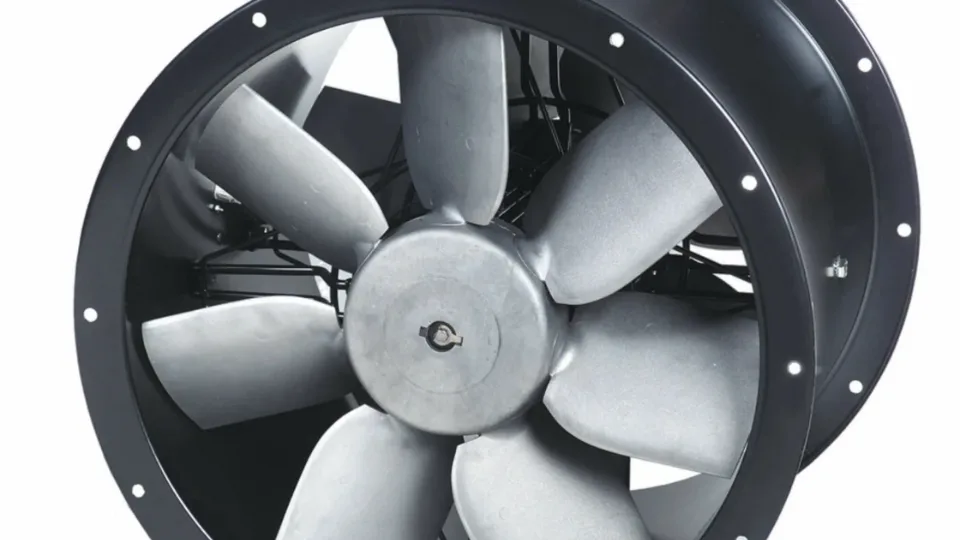
In many HVAC plants and tunnel or car-park systems, the first visible rotating equipment is an axial fan. Air enters along the shaft and leaves in the same direction, which makes these fans compact and straightforward to install in ducts or openings.
When engineers need high airflow at relatively low to medium pressure, axial fans often provide an efficient solution. The way blades shape and guide the air stream decides how stable and quiet that AIRFLOW CONTROL will be.
How an Axial Fan Moves Air
Flow direction and energy transfer
Axial fans work a bit like propellers. Air enters the fan axially, passes through rotating blades, and continues along the shaft direction. As the impeller turns, it adds energy to the air, increasing its velocity and a modest amount of pressure.
Guide vanes or casings around the blades can straighten the flow, recover some swirl losses, and improve overall efficiency. This combination gives axial fans their typical high-flow, low-to-medium-pressure performance envelope.
Key performance characteristics
When engineers review axial fan data, they pay attention to:
- Volume flow rate (m³/h or CFM) at defined pressure
- Efficiency at duty point and over the curve
- Sound power levels and frequency spectrum
- Allowable temperature and density ranges
These characteristics set how well the fan will support comfort ventilation, smoke extraction, or process exhaust under real conditions rather than just on paper.
Main Axial Fan Types
Tube axial fans
Tube axial fans mount in a cylindrical casing, with blades attached directly to the hub. They:
- Offer simple construction and straightforward duct installation
- Suit general supply and exhaust applications
- Work best where pressure demands stay modest and noise targets are moderate
They often appear in short duct runs, industrial spaces, and basic extract systems.
Vane axial fans
Vane axial designs add guide vanes downstream—or sometimes upstream—of the impeller. The vanes:
- Straighten the swirling flow to recover pressure
- Increase efficiency at given flow and pressure
- Provide more stable performance across a broader operating range
These fans suit higher-pressure duties in HVAC systems, including some smoke-control and high-capacity exhaust applications.
Propeller and roof axial fans
Propeller fans use open blades without a full duct casing, often in wall or roof-mount configurations. They:
- Move large volumes of air against very low resistance
- Fit well in general ventilation for warehouses, agricultural buildings, or simple exhaust points
- Rely heavily on free-area sizing and correct mounting to avoid recirculation
Roof-mounted axial units integrate weather protection, backdraft control, and sometimes attenuation in a compact assembly.
When Axial Fans Make Sense
Typical application areas
Axial fans support a wide range of systems:
- Fresh air supply and exhaust for industrial halls and car parks
- Tunnel jet fans where long-throw, directional flow controls smoke and pollutants
- Stair and lobby pressurization fans in coordinated FIRE SAFETY strategies
- Condenser fans and other packaged equipment where space and weight are limited
In these roles, the combination of high flow, relatively light weight, and compact footprint provides practical value.
Limits engineers watch
Axial fans do not suit every task. Design teams watch for:
- System resistances that approach the upper pressure range of the fan
- Strongly varying operating conditions that could drive the fan into stall regions
- High-contamination or particulate loads that may erode blades and housings
Where system pressures or contamination become too demanding, centrifugal designs often take over.
Axial vs Centrifugal Fans
Flow path and pressure capability
Centrifugal fans pull air in axially and discharge it radially. That geometry:
- Handles higher pressures for the same impeller diameter
- Supports heavy duct systems with more fittings and longer runs
- Often gives better tolerance to filters, coils, and complex duct branches
Axial fans keep the flow path straight, which:
- Reduces casing complexity and weight
- Works well when ductwork remains relatively short and simple
- Fits situations where installation space lies in-line with the air path
Efficiency and noise
At low to medium pressure with well-designed systems, axial fans can offer strong efficiency and good acoustic performance. Centrifugal fans may outperform them where static pressure rises or where detailed noise shaping is essential through selection of scroll and outlet geometry.
Careful selection from YAOAN VENTILATION’s fan range lets designers place each fan type where it operates in a stable, efficient region of the curve and meets project noise limits.
Design and Operation Considerations
Installation and inlet conditions
Axial fans respond strongly to inlet and outlet conditions. To protect performance:
- Provide straight runs or flow-straightening elements upstream where possible
- Avoid sharp elbows directly at the inlet or discharge
- Align and support ductwork so loads do not distort the casing
Good inlet conditions reduce swirl and uneven loading across the impeller, which supports lower vibration and higher efficiency.
Control methods
Speed control through variable frequency drives offers fine-tuned AIRFLOW CONTROL while managing energy use. On/off or staged control can work where loads change in steps. Control strategies should respect stall margins and manufacturer limits for minimum and maximum speeds.
Maintenance
Maintenance tasks focus on:
- Checking blade condition and fasteners
- Monitoring vibration and bearing temperatures
- Inspecting casings, guards, and electrical connections
- Cleaning deposits that affect balance or airflow
Regular inspection protects reliability in both comfort and fire-mode operation.
FAQ
What is an axial fan used for?
An axial fan moves air parallel to its shaft, which makes it useful for high-flow, low- to medium-pressure duties. Typical uses include supply and exhaust ventilation, tunnel and car-park systems, condenser fans, and stair or lobby pressurization where space and weight are constrained.
What’s the difference between axial and centrifugal fans?
Axial fans move air along the shaft direction and excel at high flow with moderate pressure. Centrifugal fans draw air in axially and discharge radially, supporting higher pressures and more complex duct systems. The choice depends on required duty, layout, and overall system resistance.
Where is the axial fan HVAC?
In HVAC systems, axial fans appear in wall or roof exhaust units, inline duct fans, jet fans in car parks and tunnels, and some air-handling or packaged units. They sit wherever designers need in-line airflow and have relatively low static pressure compared with large ducted centrifugal systems.
What is the main function of a fan?
The main function of a fan is to move air and create a pressure difference that overcomes system resistance. That movement supports ventilation, cooling, heating distribution, smoke control, and contaminant removal in buildings and industrial processes.
What are the disadvantages of axial fans?
Axial fans generally offer lower pressure capability than comparable centrifugal fans and can become unstable if forced to operate far from their design point. They are sensitive to poor inlet and outlet conditions, and high system resistances may require larger diameters or higher speeds than practical.
What are the three types of axial fans?
Many practitioners group axial fans into tube axial, vane axial, and propeller types. Tube axial units mount in cylindrical casings, vane axial designs add guide vanes for improved pressure and efficiency, and propeller fans serve low-resistance openings such as walls or roofs.
What are the three types of fans?
In HVAC work, three broad categories often appear: axial fans, centrifugal fans, and mixed-flow fans that blend characteristics of both. Each type serves different combinations of airflow, pressure, noise, and layout requirements.
About YAOAN VENTILATION
YAOAN VENTILATION delivers optimized air and airflow management solutions backed by nearly three decades of engineering experience. Since 1996, we have focused on industrial-grade ventilation and fire protection systems for commercial buildings, infrastructure, and specialized environments. Our axial and centrifugal fan ranges, smoke-control components, dampers, silencers, and precision-built aluminum ventilation parts support applications from car parks and tunnels to plantrooms and shafts. By matching fan type, duty point, and control strategy, YAOAN VENTILATION helps projects achieve stable AIRFLOW CONTROL, reliable FIRE SAFETY performance, and efficient operation across the full life cycle.