Table of Contents
ToggleFlexible Duct in Real Ceiling Voids
Look inside a typical ceiling void and you see a mix of rigid trunks and short runs of flexible duct. The rigid duct carries most of the air. Flexible duct finishes the last part of the route, connecting to diffusers, grilles, or small branches where space becomes tight.
Used correctly, flexible duct adds speed and tolerance to installation. Used carelessly, it adds pressure loss, noise, and unpredictable AIRFLOW CONTROL.
Inside the Construction of Flexible Duct
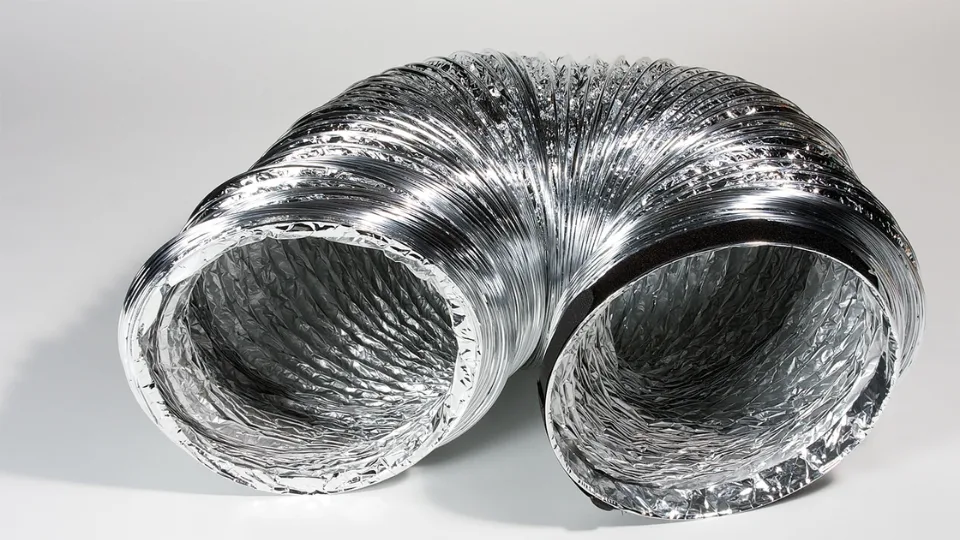
Flexible duct products share the same basic idea: a helical support with a flexible air path around it. Variants differ in layers and performance.
Common HVAC types include:
- Uninsulated flex – Helical wire with a polymer or aluminum inner liner; suited to short connections in conditioned voids.
- Insulated flex – Inner liner plus thermal insulation and outer jacket; used where temperature control and condensation resistance matter.
- Acoustic flex – Similar to insulated but optimized for sound attenuation to quiet terminals or noisy equipment.
Manufacturers rate each product for maximum pressure, temperature, and velocity. Designers should match those limits to the system’s duty rather than assuming all flex performs the same.
Length, Pressure, and Routing Limits
Flexible duct behaves very differently from straight, smooth rigid duct. Extra friction and turbulence appear whenever installers stretch, bend, or compress it.
Key practical limits:
- Keep individual flexible runs short, typically only the final few meters or feet to each outlet.
- Avoid sharp bends; use large-radius curves and minimize changes of direction.
- Stretch flex fully without compression to reduce internal corrugation and friction.
- Respect the product’s stated maximum pressure; high static systems belong on rigid ducts.
When layouts treat flexible duct as long main trunks, fans face higher pressure drops than expected and may not deliver design airflow to every diffuser.
Where Flexible Duct Makes Sense
Flexible duct fits best as a finishing tool, not as the structural backbone of the system. It works well when:
- Installers need to reach diffusers that sit off the main duct line.
- Designers must navigate around beams, lights, and sprinklers in tight ceiling zones.
- Acoustic performance near terminals benefits from a short flexible, insulated section.
It suits low- and medium-pressure comfort systems with moderate velocities and clean air. Smoke-control, high-temperature, or heavily contaminated systems usually require rigid metallic ductwork and dedicated fire-rated details.
Flexible vs Rigid Ductwork
Rigid ducts (rectangular or round):
- Carry main flows with lower friction and predictable pressure loss.
- Offer better shape stability, easier balancing, and tighter leakage control.
- Support higher pressures and velocities with proper construction standards.
Flexible ducts:
- Provide quick, adaptable connections over short distances.
- Reduce fitting counts in tight spaces but increase resistance if overused.
- Offer good acoustic decoupling between rigid duct and terminal when sized and installed correctly.
A balanced design lets rigid duct handle structure and capacity while flexible duct handles local adjustment in the last meters.
Installation and Inspection Checklist
A practical field checklist keeps flexible duct performance under control:
- Sizing – Match inside diameter to the design airflow and velocity; do not undersize.
- Stretch – Pull the duct to full length before fixing supports and collars.
- Supports – Use wide, smooth hangers at reasonable spacing to avoid kinks and sagging.
- Bends – Maintain large bend radii; avoid “S” bends and tight turns.
- Connections – Fix flex to collars with bands or clamps, then seal according to the project’s leakage class.
- Length control – Limit each run to the project standard and switch to rigid duct when distance exceeds that limit.
During maintenance, teams should visually check flexible sections for crushing, tears, disconnected collars, and insulation damage whenever ceilings open for other work.
FAQ
What is a flexible duct?
A flexible duct is a bendable air conduit built from a helical wire core with a flexible inner liner and, often, insulation and an outer jacket. HVAC contractors use it mainly for short connections between rigid ductwork and diffusers or grilles where alignment changes or space constraints make rigid duct difficult.
What does a flex duct look like?
Flex duct usually appears as a round, corrugated hose with a shiny foil or plastic outer jacket, often wrapped in insulation. You see it as coiled or gently curved lengths in ceiling voids, plantrooms, or roof spaces, bridging from solid ducts to terminals or small branches.
What is the main problem with flex ducts?
The main problem arises when installers run flex too long, leave it compressed, or introduce tight bends. Those conditions increase friction, reduce effective diameter, and create uneven airflow. The result can be poor room performance, extra fan power, and more noise than the design predicted.
What are the advantages of flexible ducting?
Flexible ducting offers quick installation, easy routing around obstacles, fewer rigid fittings, and useful acoustic decoupling between main ducts and terminals. It helps adjust outlet positions late in the project without major rework, as long as designers keep runs short and respect pressure and velocity limits.
How long do flexible air ducts last?
Service life depends on material quality, temperature, UV exposure, handling, and support. In protected indoor ceiling voids with proper installation, flexible ducts can operate for many years. In hot, exposed, or heavily accessed areas, jackets and liners may age faster and require earlier replacement.
What are the four rules for flexible ducts?
Simple rules many teams follow include keeping runs short, stretching ducts fully, avoiding tight bends, and supporting them properly. Adding secure, sealed connections as a fifth rule ensures that air reaches terminals with predictable flow and that AIRFLOW CONTROL stays stable over time.
Is flex duct cheaper than ductwork?
Flex duct often costs less per meter to install for short connections because it reduces fabrication and fitting time. However, using flex instead of rigid for long runs can raise life-cycle cost through higher pressure drop, larger fans, and potential rework when airflow or noise performance fails to meet expectations.
What type of ductwork is best for HVAC?
For main trunks and higher-pressure systems, well-designed galvanized steel rectangular or spiral round ductwork usually performs best. Flexible duct is best reserved for final connections and local adjustments. The most effective systems combine both types, using each where it supports performance and practicality.
Does flex duct reduce noise?
A short, insulated flex run between rigid duct and a diffuser can help reduce transmission of fan and duct-borne noise. However, if air velocity inside the flex becomes too high or the duct kinks, turbulence noise can increase. Noise control depends on careful sizing and installation, not flex alone.
About YAOAN VENTILATION
YAOAN VENTILATION delivers optimized air and airflow management solutions backed by nearly three decades of engineering experience. Since 1996, we have focused on industrial-grade ventilation and fire protection systems for commercial buildings, infrastructure, and specialized environments. Our product portfolio includes fans, dampers, smoke-control components, silencers, and precision-built duct accessories engineered to work with both rigid and flexible duct systems. By combining sound duct design with clear guidance on flex-duct selection and installation, YAOAN VENTILATION helps projects maintain stable AIRFLOW CONTROL, predictable pressure losses, and reliable performance throughout the life of each system.