Table of Contents
ToggleAir Ducts as the Framework of an HVAC System
Fans, filters, and diffusers all depend on one thing: a stable air path. Air ducts provide that path and turn fan pressure into controlled AIRFLOW CONTROL throughout the building.
If the duct system uses the right materials, sizes, and installation methods, the HVAC plant can deliver design airflow with predictable noise and energy use. Poor ductwork design or installation turns even the best equipment into a constant source of complaints and inefficiency.
Common Air Duct Materials and Forms
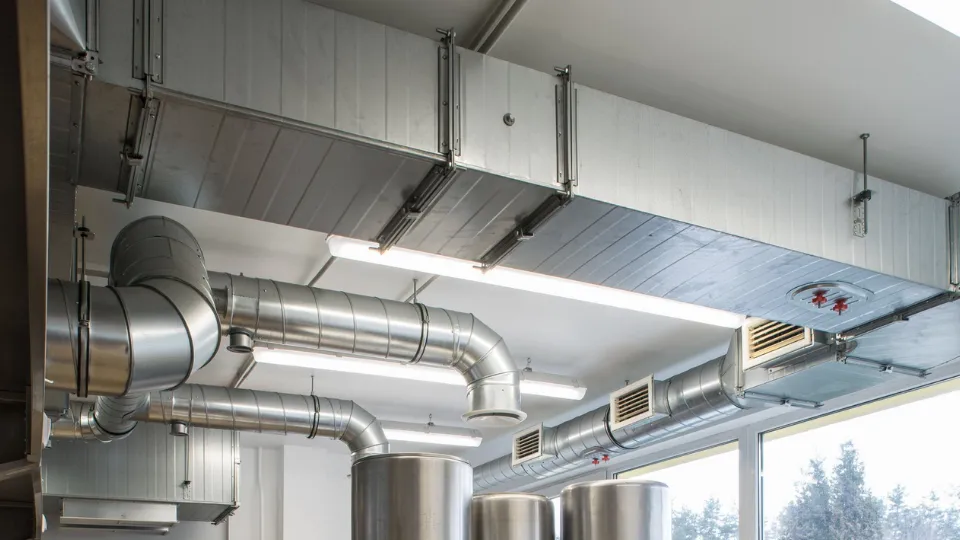
Galvanized steel rectangular ducts
Galvanized steel (GI) remains the standard for many commercial and industrial projects. It offers:
- Good strength and shape retention over long spans
- Broad compatibility with fire protection, acoustic lining, and insulation
- Well-understood fabrication methods and leakage classes
Rectangular ducts fit tight ceiling voids and coordinate with beams and services, but they require careful sealing at seams and flanges to keep leakage under control.
Spiral round ducts
Spiral round ducts provide a different balance of performance and installation effort. Key advantages include:
- Lower surface area and friction loss for the same airflow compared to many rectangular layouts
- Fewer joints and a natural tendency toward lower leakage when installed correctly
- Clean appearance in exposed installations such as retail or industrial interiors
For both GI rectangular and spiral round ducts, stiffness class and jointing system must match design pressure and support spacing.
Flexible ducts and special constructions
Flexible ducts help connect diffusers or grilles to nearby branches. They should:
- Remain short and reasonably straight to limit pressure loss
- Avoid sharp bends, kinks, or compression that reduce effective diameter
- Use insulation and vapor barriers consistent with the rest of the system
Special constructions, such as textile ducts or double-wall ducts, appear in specific acoustic or hygienic applications and need matching design rules.
Duct Size Calculation and Airflow Performance
Linking duct size to velocity and pressure
Duct sizing always balances three factors:
- Airflow (m³/h or CFM)
- Velocity in each section
- Resulting pressure drop
Higher velocity allows smaller ducts but increases friction loss and noise. Lower velocity reduces noise and pressure but may demand more space and material. The design team chooses target velocities by system type: supply, return, exhaust, and special-use ducts often follow different ranges.
Methods for sizing
Engineers typically use:
- Equal friction methods, which aim for a common pressure gradient along main trunks
- Static regain methods for larger, higher-pressure systems that need tight balancing
- Simple lookup methods for small branches and terminals
Regardless of method, the outcome must align with available fan pressure, leakage class, and acceptable noise levels. Oversized ducts may look conservative but can complicate coordination and support. Undersized ducts lead to poor distribution and unstable operation.
Installation Practices and Standards on Site
Supports, alignment, and sealing
Quality installation protects both mechanical integrity and AIRFLOW CONTROL. Practical rules include:
- Support spacing that respects duct size, material, and insulation weight
- Straight alignment with smooth transitions at offsets and branches
- Properly sealed joints with mastics, tapes, or flanges that match the specified leakage class
Misaligned joints, undersized supports, and missing sealant quickly translate into vibration, noise, and energy loss.
Fire and smoke-related details
Ducts often pass through fire compartments and smoke-control zones. Installers must:
- Place and fix fire and smoke dampers exactly where drawings and fire details indicate
- Maintain clearances and firestopping at walls and floors
- Keep access doors reachable for inspection and cleaning
These details support the broader FIRE SAFETY strategy rather than treating ducts as neutral elements.
Coordination with other trades
Ceiling voids and shafts hold many systems. Effective duct installation depends on:
- Early coordination of elevations and routes with structure, piping, and cable trays
- Clear site drawings and riser diagrams that match built conditions
- Practical access around ducts for future maintenance
Well-coordinated ductwork reduces rework and supports stable commissioning.
Cleaning and Maintenance of Air Ducts
Why ducts need periodic attention
Even in clean buildings, ducts accumulate dust, fibers, and in some cases microbial growth on damp surfaces. Over time, this buildup can:
- Increase pressure drop and reduce available airflow
- Affect indoor air quality in sensitive spaces
- Interfere with dampers, sensors, and access doors
A planned maintenance program addresses these risks before they impact occupants and equipment.
Inspection and cleaning approaches
Facility teams should:
- Inspect representative sections near filters, coils, and exhaust points
- Check internal surfaces at access doors for dust layers or visible contamination
- Confirm that insulation remains intact and dry
When cleaning is justified, methods may include brushing, vacuuming with HEPA-filtered equipment, and controlled air washing. Any chemical treatments must align with project health and environmental requirements.
Linking duct condition to system performance
Duct maintenance ties directly to measurable performance:
- Restored airflow and reduced fan effort after removing heavy deposits
- More accurate readings from pressure and airflow sensors
- Improved stability of temperature and contaminant control in critical zones
Clear records in O&M manuals help operators track when ducts last received inspection and cleaning, and which sections carry highest priority.
FAQ
What does an air duct do?
An air duct provides a controlled path for supply, return, or exhaust air in an HVAC system. It connects fans and air-handling units to rooms and grilles so the system can deliver, collect, and remove air according to the design airflow plan.
What is the difference between air ducts and vents?
Air ducts carry air between equipment and spaces, usually hidden in ceilings, shafts, or plant areas. Vents, such as grilles and diffusers, are the visible terminations of those ducts where air enters or leaves the occupied zone.
What is air duct pipe?
Air duct pipe usually refers to round duct sections, which can be spiral-wound metal, smooth round steel, or flexible duct. These pipes form part of the duct system and route air between equipment, branches, and terminals.
Where is the air duct located?
Air ducts run wherever the design requires an air path: above ceilings, inside vertical shafts, in plantrooms, and sometimes exposed in occupied spaces. Their routes follow structural bays and service corridors, connecting central equipment to each zone.
Is it expensive to replace air ducts?
Replacement cost depends on building size, accessibility, material choice, insulation, and whether the project occurs during renovation or full occupation. While duct replacement can be significant, improved airflow, lower leakage, and better energy performance often justify the investment in older or badly damaged systems.
Does homeowners insurance cover air duct cleaning?
Coverage varies by policy and jurisdiction. Many standard policies treat duct cleaning as maintenance rather than an insured event, but specific damage from covered incidents may qualify. Owners should review their own policy wording or consult their insurer for definitive guidance.
How often should home air ducts be replaced?
There is no fixed interval, but ducts may need replacement when they show corrosion, physical damage, persistent contamination, or poor performance that cleaning and repair cannot address. A qualified HVAC professional can evaluate condition and advise whether repair, sealing, or full replacement makes technical and economic sense.
What do air ducts look like?
Air ducts typically appear as rectangular or round metal channels, sometimes insulated with external jackets. In exposed installations they form visible runs along ceilings or walls; in concealed systems they sit above ceilings or in shafts, accessed through hatches and plantrooms.
About YAOAN VENTILATION
YAOAN VENTILATION delivers optimized air and airflow management solutions backed by nearly three decades of engineering experience. Since 1996, we have focused on industrial-grade ventilation and fire protection systems for commercial buildings, infrastructure, and specialized environments. Our portfolio includes fans, dampers, smoke-control components, silencers, and precision-built aluminum and steel duct accessories designed to integrate with rectangular and spiral duct systems. By pairing robust equipment with sound duct design, sealing, and maintenance guidance, YAOAN VENTILATION helps projects achieve low-leakage ductwork, stable AIRFLOW CONTROL, and consistent performance throughout the system life.