
Where Factory Acceptance Testing Fits in HVAC Projects
Before a ventilation system reaches a job site, project teams already carry risk. Fans, dampers, control panels, and packaged systems must perform as specified when the schedule leaves little room for surprises.
Factory Acceptance Testing (FAT) sits at this point in the lifecycle. It acts as a structured, witnessed check that equipment from the factory matches drawings, specifications, and control logic before shipment. For critical ventilation and smoke-control equipment, FAT also reinforces trust between manufacturer, contractor, and owner.
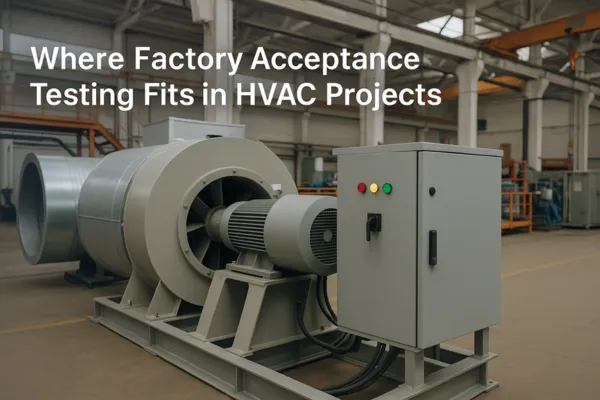
From Specification to Test Bench: Building the FAT Scope
A solid FAT starts long before anyone powers up a fan on the test floor. The process usually follows a clear sequence:
- The project team defines FAT requirements in the specification and purchase order.
- YAOAN VENTILATION prepares a test procedure and submits it for review.
- The customer reviews and comments on the FAT protocol and acceptance criteria.
- Both sides agree on the attendance list, schedule, and documentation format.
That alignment prevents disputes on the day of the test and keeps everyone focused on objective results instead of expectations.
Typical FAT Content for Ventilation Equipment
For fans, packaged ventilation units, or smoke-control assemblies, FAT normally covers several categories of checks.
Visual and dimensional verification
Engineers confirm:
- Model, nameplate data, and rotation direction
- Materials, coatings, and construction details
- Dimensions, connection sizes, and orientation against drawings
- Safety guards, access panels, and lifting points
This step ensures that the delivered unit matches the approved submittals and fits the intended shaft, plinth, or duct connection.
Functional and performance testing
Depending on the project, FAT may include:
- No-load and load runs to check vibration and noise
- Airflow or pressure performance at selected duty points (when test facilities allow)
- Motor current and power draw checks
- Operation of dampers, actuators, backdraft devices, and position switches
For smoke-control or tunnel fans, teams often place extra focus on start-up behavior, direction control, and any high-temperature features specified in the contract.
Controls, safety, and interlocks
FAT for modern HVAC equipment also verifies control and safety logic:
- Local/remote and auto/manual modes
- Emergency stop functions and restart behavior
- Feedback signals for status, alarms, and measured values
- Integration points for BAS or SCADA systems
Witnesses review wiring diagrams and points lists while they observe tests to confirm that logic and documentation match.
Customer Witnessing and Collaboration During FAT
FAT brings customer and manufacturer teams into the same space at the same time. That session offers more than a checklist.
Project stakeholders may include:
- Owner or operator representatives
- Consultant or designer
- Main contractor and HVAC contractor
- YAOAN VENTILATION engineering and QA personnel
During the test, customers can ask detailed questions, request demonstrations of specific functions, and clarify maintenance or operating procedures. When everyone sees the unit under power and under control, later site work often runs smoother.
If small nonconformities appear—such as label updates or parameter adjustments—the team can agree on corrective actions and record them directly in the FAT report. This transparency strengthens confidence in the final product.
Documentation, Standards, and Traceability
A rigorous FAT does not end when the test bench stops. It ends when the documentation set supports long-term traceability.
A complete FAT package usually includes:
- Approved FAT procedure and checklists
- Test data sheets with measured values and tolerances
- Calibration certificates for critical instruments
- Photographic records of key configurations
- A punch list and closure records for any corrective actions
- Signatures from YAOAN VENTILATION and customer witnesses
Where relevant, FAT also references product standards, such as performance testing methods, motor efficiency classes, or fire-resistance classifications. This link between standards and measured results shows that the product meets both project and regulatory expectations.
How FAT Reduces Project Risk
For ventilation and smoke-control systems, late-stage failures can trigger delays, rework, and safety concerns. FAT reduces those risks in several ways:
- It catches wiring or logic errors before equipment ships.
- It verifies that special functions for smoke control or emergency modes work as intended.
- It gives the site team a clear baseline for Site Acceptance Testing (SAT) and commissioning.
- It documents quality controls that support future audits or incident investigations.
FAT does not replace SAT or integrated system tests, but it gives those later steps a stronger foundation. When equipment arrives with a passed FAT behind it, site work can focus on integration instead of basic troubleshooting.
FAQ
What is the factory acceptance test fat?
A factory acceptance test, or FAT, is a structured test that the manufacturer performs at the factory before shipment. It confirms that equipment meets specifications, functions correctly, and matches approved documents. Customers often attend or witness FAT to verify performance and quality controls for critical systems.
What is the difference between ITP and fat?
An Inspection Test Plan (ITP) maps all inspections and tests across a product or project lifecycle, including who performs them and when. FAT represents one key event inside that plan. The ITP gives the overview and sequence; the FAT focuses on detailed checks at the factory before delivery.
What is the purpose of fat and SAT?
FAT verifies equipment performance and functionality at the factory, under controlled conditions. SAT, or Site Acceptance Test, checks that the same equipment operates correctly after installation, connection to field devices, and integration with other systems. Together, they reduce risk between production, delivery, and final handover.
What is the difference between fat and UAT?
FAT applies mainly to physical equipment or systems and takes place at the manufacturer’s facility. UAT, or User Acceptance Testing, usually refers to software or digital systems and focuses on whether end users can complete their tasks as intended. Both seek acceptance, but they apply to different domains and test methods.
Why would a doctor order a fat test?
A doctor may order a blood fat test, often called a lipid profile, to measure cholesterol and triglyceride levels. Those results help assess cardiovascular risk and guide lifestyle or medication decisions. Patients should always discuss results and implications directly with a qualified healthcare professional.
How do you prepare for a factory acceptance test?
To prepare for FAT, the project team reviews the agreed test procedure, confirms acceptance criteria, and checks that drawings and documents match the equipment. Witnesses bring relevant specifications and questions. The manufacturer prepares calibrated instruments, test setups, safety measures, and draft data sheets so the session runs efficiently.
Did Mark Zuckerberg score 1600 on SAT?
Open sources often report that Mark Zuckerberg achieved a perfect 1600 score on the old SAT. Exact details belong to his personal academic history and do not affect engineering practice, but the story appears frequently in public discussions about his early academic performance.
How long does a factory acceptance test take?
FAT duration depends on equipment complexity and the depth of testing. A single standard fan may take a few hours, including visual checks and a short run test. A complex ventilation package with controls and multiple operating modes can require one or more full days to complete all planned test cases and documentation.
About YAOAN VENTILATION
YAOAN VENTILATION delivers optimized air and airflow management solutions backed by nearly three decades of engineering experience. Since 1996, we have focused on industrial-grade ventilation and fire protection systems for commercial buildings, infrastructure, and specialized environments. Our portfolio includes fans, fire dampers, smoke control components, silencers, and precision-built aluminum ventilation parts, each produced under defined FAT and quality-control procedures. By combining witnessed factory testing with robust engineering and documentation, YAOAN VENTILATION helps projects reduce risk, shorten commissioning, and gain long-term confidence in every installed system.